
Torch vs BetterUp: choosing the right leadership coaching program

In this article
If you need to help leaders tackle a specific business challenge, Torch offers experienced human coaches working on agreed leadership capacities, with feedback collected both before and after the program. This combination gives your talent team a basis for program design, communication and evaluation.
BetterUp is also a strong contender for organization-specific development. It offers leadership coaching, manager development, resilience and AI coaching, with tailored products for different groups. The decision isn't about which company “does coaching”, but rather which proposed program aligns with your people and your priorities.
- Bring a defined cohort. An executive team, new managers and an entire workforce each require different kinds of support.
- Both can use company context. Look at how your priorities will be reflected in the coaching approach, assessments and reporting.
- Separate human coaching from AI access. Verify the experience and allocation each participant will receive.
- Decide what progress should look like. Agree on what evidence of progress you need before selecting a package.
First, identify the BetterUp product you need
BetterUp’s current portfolio includes Lead for leadership and critical talent, Manage for people managers, Grow for AI coaching, and Ready for resilience and adaptability. Consider these as starting points for discussing the right configuration for your needs.
BetterUp Lead combines individual coaching with assessment and additional development support. Manage integrates coaching, AI practice and peer learning for managers. If you're supporting senior leaders, you'll want to ask different questions than if you're expanding access across a large manager population.
BetterUp offers a distinctive program through its Center for Daring Leadership, developed with Brené Brown. This brings the Dare to Lead approach into organizational development through coaching and learning experiences. If your company already uses this language and curriculum, maintaining continuity is a practical reason to explore the program.
Coaching for smaller teams and department-level programs
Some businesses have recently told us that BetterUp declined to work with them because of their size. If you’re considering a smaller engagement, ask BetterUp to confirm eligibility and any minimum commitment in its custom proposal.
Torch works with smaller L&D teams and companies that want to develop leaders within a single department. You can scope one-to-one leadership coaching, team coaching or the Sponsored Mentoring Program around the people and goals involved, with delivery and pricing agreed in the proposal.
Include team performance and advancement in the brief
Torch’s dynamic team coaching focuses on one coach with an intact team, including its manager. The emphasis is on how that team performs together: making decisions, handling disagreements and following through on shared commitments. Individual coaching and peer-group coaching are still available as separate options. BetterUp Manage also provides facilitated Team Coaching and Team Pulse check-ins, so you'll want to compare the actual team engagement each program offers.
Torch’s Sponsored Mentoring Program pairs an internal executive sponsor with a professional Torch coach to support rising leaders. The sponsor creates opportunities for stretch work and advocates for the leader, while the coach helps develop the skills needed to succeed in those opportunities. Torch curates sponsor pairings for approval and matches each rising leader with a coach.
This approach gives you a clear framework to evaluate a succession or promotion-readiness program: who provides opportunities, who develops the individual, and how they track progress together. Ask both providers to demonstrate how these responsibilities would be addressed in your specific program.
Put your leadership framework into the demonstration
A useful leadership model should reflect the work people actually face. If your managers need to lead a restructuring, telling them to “communicate better” isn't sufficient. They might need to explain changing responsibilities, bring disagreements to light early, and make decisions without waiting for perfect information.
Torch’s leadership-capacity framework offers a structured way to discuss these demands and agree on development priorities. The appeal is having a coherent program where the work leaders bring to coaching, the capacities they develop, and the feedback collected should all align with the same purpose.
BetterUp offers its Whole Person Model, which addresses mindsets and behaviors related to both performance and well-being. According to their documentation, at certain partnership levels, behavioral scientists can map this model to an organization's specific competencies and language. The documentation also describes briefing coaches on program goals and company context. Having a proprietary framework doesn't mean the program would ignore your existing one.
Include at least one of your existing competencies in each demonstration. Ask to see what participants would read about it, how coaches would incorporate it, and which assessment questions would reflect it. If a proposal promises alignment but can't explain these connections, request the missing design work before committing.
Make AI enablement a concrete coaching brief
Torch’s AI Enablement program combines six months of one-to-one coaching focused on agility and adaptability with coach-directed use of Spark, Torch’s unscored AI conversation-rehearsal tool. The program also includes three expert-led small-group sessions at key intervals, with the facilitator and delivery scope to be agreed in the proposal.
The key question is how the leader will actually apply AI in their work. Use a real adoption scenario to integrate coaching, rehearsal and practical application. Then compare this approach with the human-and-AI combination BetterUp proposes for the same group, noting who guides participants between sessions.
Look at the coaches your leaders would meet
Every Torch coach is ICF-credentialed and has at least five years of coaching experience. Their published profiles include professionals who have held senior roles in operations, people management, and professional services. For leaders facing significant decisions, this combination of coaching expertise and relevant professional experience is an important aspect of Torch's offering.
BetterUp Lead also provides coaching with professional human coaches. Be sure to evaluate the specific coaches available for the product and population in your proposal, rather than assuming that a general network description indicates who a particular executive would work with.
A valuable shortlist should include sufficient detail to assess fit: experience with similar responsibilities, coaching approach, language capabilities, availability, and the process for changing a coach match. Ask how the coach would handle a realistic scenario, such as a high-performing leader whose peers have lost trust in their decisions.
Credentials show professional qualifications, but they don't establish whether a specific coach and leader will work well together. The size of a coaching network doesn't guarantee better matches either. Focus on evaluating the specific coaches proposed for your program.
Give AI practice a specific job
BetterUp Grow provides AI coaching and roleplay that can be tailored to your company's strategy, values and competencies, with examples that include practicing feedback and workplace conversations. Assess whether these examples align with the actual challenges your team members face.
Torch offers two distinct practice options. Spark provides unscored conversation rehearsal, while the scored skills-practice library comes from Praxis Labs by Torch, which uses defined scenarios and skill rubrics. Be clear about which option you prefer and how it integrates with your human-coaching engagement.
For instance, a manager who keeps putting off a difficult conversation might use rehearsal to practice opening the discussion and responding to resistance. The coaching conversation that follows can explore why the issue feels challenging and what happened when the manager took action. Assigned scored practice addresses a different need: structured repetition and feedback on specific skills.
BetterUp’s trust and security information explains their approach to confidentiality and aggregated reporting. Torch’s Spark documentation indicates that transcripts remain private to the participant and audio is not stored. Verify the terms for the specific tools you're purchasing, including any scored-practice products, rather than assuming one feature's policy applies to the entire program.
Agree on the evidence and the complete price
Torch’s coaching model includes a 360 at the beginning and end of the program. Agreeing on leadership capacities and keeping the assessment consistent creates a foundation for discussing changes reported by colleagues. BetterUp’s Whole Person documentation outlines their approach to repeated assessment, including a People Analytics Dashboard, manager feedback and additional 180/360 assessments. Confirm which assessments are included in your package and when they would be administered. Both proposals merit careful examination of what's being measured, who's responding, and what information you'll receive.
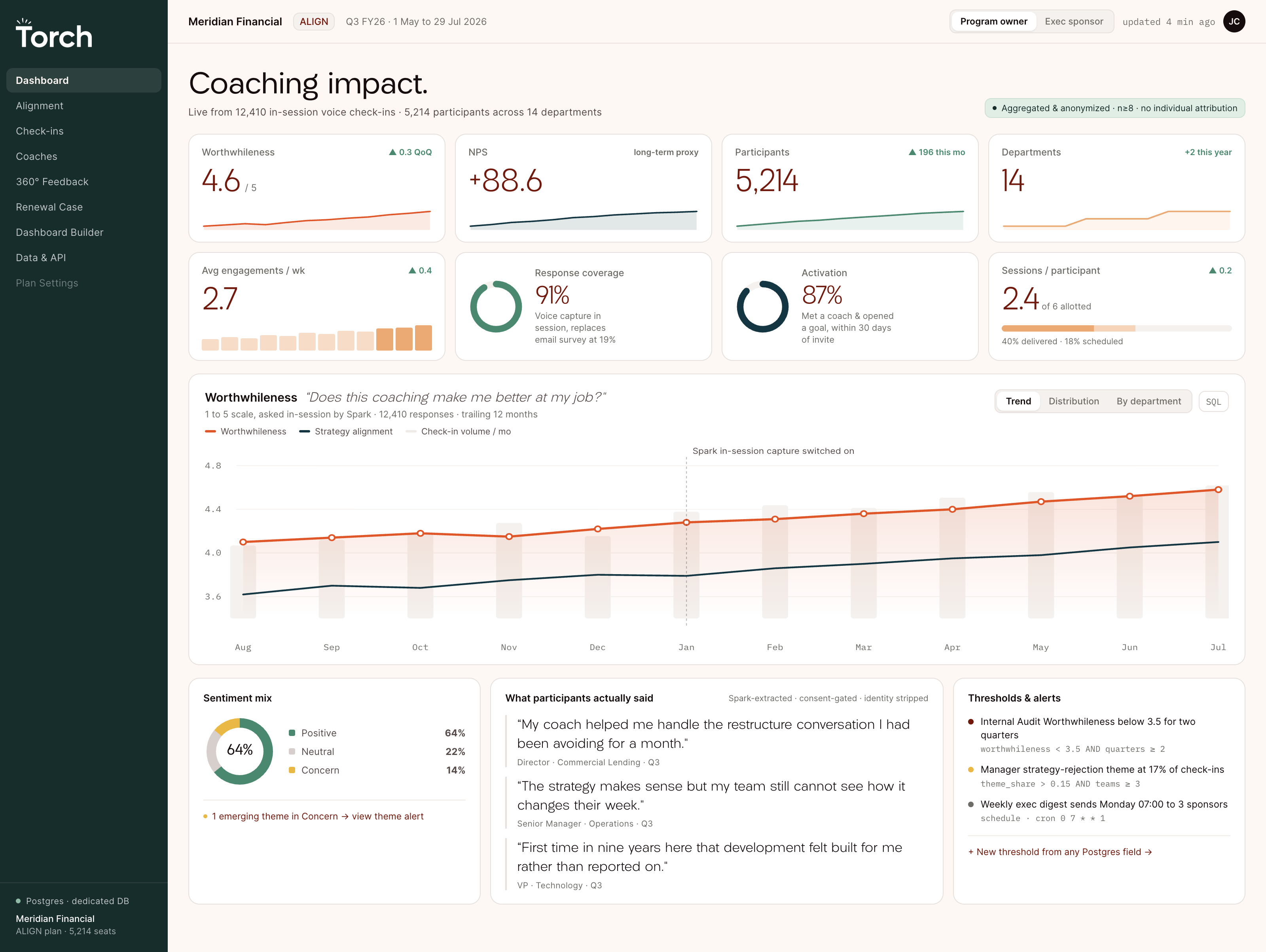
Torch’s Worthwhileness dashboard concept is designed to display participants' views on coaching's usefulness alongside participation and engagement trends, giving program leaders a way to consider both the experience and its usage together and decide where to focus follow-up efforts.
 View full size
This discussion should lead to a clear renewal question. Perhaps you need evidence that managers are delegating more effectively, or that leaders are handling disagreement constructively. While participation and satisfaction help explain program usage, they don't answer every question about behavior change.
| Decision | What to request |
|---|---|
| Population | Named cohorts, eligibility and the product or format each receives. |
| Human support | Session allocation, coach selection, access between sessions and rematching. |
| Assessment | Questions, raters, timing and a sample report for the proposed program. |
| AI and learning | Included tools, optional modules, permissions and additional charges. |
| Full commitment | Delivery responsibilities, total fees, term and renewal conditions. |
If you need to calculate financial return, set that up as a separate exercise. A change in 360 ratings doesn't prove that coaching caused retention or revenue improvements. You'll need a specific business metric, program costs, and a defensible method to evaluate coaching's contribution. Comparing different providers' headline outcome percentages won't solve this issue.
Which program belongs on your shortlist?
Choose Torch for a focused coaching and assessment design
Torch makes sense when you want experienced human coaching for your organization or a single department, with development tailored to agreed leadership capacities and structured assessments before and after. Consider dynamic team coaching for collective performance, or the Sponsored Mentoring Program when emerging leaders could benefit from executive access and challenging assignments alongside coaching. Add practice only where it addresses a specific development need.
Choose BetterUp when its product mix fits your populations
BetterUp is worth considering when you want to explore different offerings for leaders, managers, resilience and broad AI access within its platform. Their Whole Person competency mapping and Dare to Lead program might align well with development approaches your company already uses. Be sure to verify the configuration and support available at your partnership level.
Present both teams with the same leadership challenge using a representative cohort. The more clearly each can demonstrate the proposed experience, coach fit and evidence plan, the easier it becomes to make a substantive decision.
Frequently asked questions
Can BetterUp work with our existing leadership competencies?
Yes. BetterUp says it can map its Whole Person Model to company competencies at certain partnership levels. Ask for the mapping, the participant experience and the reporting included in your proposal. Torch also builds development around agreed company priorities and leadership capacities.
Is BetterUp Grow the same kind of AI product as Spark?
There is overlap in conversation practice, but compare the actual experience. Grow combines AI coaching and roleplay configured to the organization. Spark offers unscored rehearsal. Torch’s scored skills-practice library comes separately from Praxis Labs by Torch; confirm which option is included.
Does a 360 assessment prove coaching ROI?
No. A before-and-after 360 shows changes reported by raters. Financial ROI needs a defined business outcome, reliable cost data and a credible way to assess what coaching contributed. Keep those questions separate from whether participants found the program useful.
Which costs less, Torch or BetterUp?
Compare scoped proposals for the same people, term, human coaching allocation, assessments, AI tools and delivery support. A broad AI-access package and a sustained human-coaching engagement have different costs and purposes; their headline prices would not settle this comparison.
What is Torch?
Torch is a leadership coaching and alignment platform for mid-market and enterprise talent teams. It brings ICF-credentialed coaches, development around company priorities and before-and-after 360 feedback into a program for your leaders. Optional AI practice can support that work between sessions.
Keep comparing with a clear brief.


Become a Torch Changemaker.