
Torch vs CoachHub: how to choose a coaching program that fits

In this article
What looks clear in a coaching proposal can become complex during implementation. Leadership levels, regions, languages, and working patterns all shape the experience. Choosing between Torch and CoachHub means determining what your people need and then verifying how each provider will deliver it.
Torch is a strong candidate when you want experienced human coaches focused on developing agreed leadership capacities, with clear assessments before and after. CoachHub offers a global coaching network with options spanning human, hybrid, and AI formats. Both providers describe development connected to business priorities, but the meaningful comparison lies in how your actual program would operate.
- Define the work first. Different needs require different approaches, from individual development to peer learning and intact-team coaching.
- Check real availability. A provider’s network size doesn’t guarantee available coaches for your specific needs.
- Evaluate the human and AI mix. CoachHub offers both human and AI coaching; define the scope of Torch’s practice options too.
- Plan for useful evidence. Determine how you’ll use feedback to guide the next development phase.
Match the coaching format to the work
CoachHub’s portfolio includes individual and executive coaching, Collective coaching, Rise hybrid coaching, and AIMY AI coaching. This variety allows buyers to support different groups in various ways. The package name matters, as two CoachHub proposals might describe different experiences.
Collective coaching facilitates peer and group work through Co-development Hubs. This approach is valuable when colleagues need to learn across departments, discuss common challenges, or build connections beyond their immediate teams.
Torch’s dynamic team coaching focuses on high-performance teamwork: one coach works with the whole intact team, including its manager. The sessions can address decision-making, clear responsibilities, and how team members handle disagreements. This gives the team a shared space to examine its performance, alongside Torch’s separate individual and peer-group coaching options.
For instance, newly appointed managers across multiple departments might benefit from individual support and peer learning opportunities. An intact leadership team facing challenges after a restructure has different needs: improving how members collaborate. Your brief should clearly distinguish between these situations. “Team development” can apply to either context, and a good proposal should specify its intended participants and format.
A different design for rising leaders
Torch’s Sponsored Mentoring Program pairs internal executive sponsorship with individual professional coaching. Sponsors provide access, advocacy and challenging opportunities, while Torch coaches develop rising leaders and help them apply feedback to that stretch work. Agreed check-ins maintain connections between all parties while keeping private coaching conversations confidential.
When building your leadership bench, consider how this approach differs from cross-functional peer learning. Determine who will provide sponsors and stretch projects, prepare participants and assess readiness. Compare these responsibilities with what CoachHub's program would cover.
Check coach standards and actual availability
Torch requires every coach to be ICF-credentialed and to have at least five years of coaching experience. The coach profiles include practitioners with operating and leadership experience. This provides talent teams with concrete standards to evaluate when supporting leaders through complex challenges.
CoachHub publishes its own coach requirements, requiring certification from a major coaching association and at least 500 hours of coaching experience. The same page mentions 10+ years of executive experience. Its matching process considers participant preferences and coach profiles, offering a shortlist for selection.
These standards use different metrics. Coaching years, hours and executive experience cannot be reduced to a simple quality ranking. Inquire about the coaches who would actually serve your population and their experience with similar responsibilities.
For a multinational deployment, create a small availability matrix first. List each cohort's language, time zone, seniority and likely scheduling constraints. Ask both providers to demonstrate suitable options against this matrix. A senior leader needing confidential support in a specific language requires more precision than “global coverage.”
Then evaluate the matching process. Who selects the coach? Can participants review relevant experience first? What happens if the match fails or schedules conflict? A credible response outlines responsibilities and a process rather than simply reassuring you about network size.
Decide where human and AI coaching belong
CoachHub Rise combines human coaching with AI support. AIMY offers AI coaching that can align with company values and goals, including video roleplay for workplace conversations. CoachHub is therefore worth considering for hybrid delivery needs, as well as for those seeking either human-only or AI-focused solutions.
For Torch, distinguish between the practice options. Spark provides unscored rehearsal. The scored skills-practice library comes from Praxis Labs by Torch. Employers wanting assigned practice with skill feedback should specifically discuss the latter, including its reporting and program scope.
The real value of a practice tool comes from how participants use it. A new manager might want to rehearse giving feedback before meeting with a direct report. A leader could work with a human coach to explore why they consistently avoid disagreement, then test a different approach in their next meeting. While these activities complement each other, they don't need the exact same learning environment.
Request that each provider walk you through their complete process: how a participant sets a goal, engages in practice, receives feedback, and determines their next steps. If their solution combines human coaching with AI, find out how they expect participants to use both components. Don't assume these tools share data or that a coach can view a participant's private AI interactions.
Build a measurement plan that travels across teams
Torch's program model incorporates a 360 at the start and end. Reach agreement on the leadership capacities you want to develop and maintain consistent assessment methods. This approach establishes a helpful foundation for discussing whether colleagues notice behavior changes over time.
CoachHub describes measurement through Insights and its (im)PACT framework, addressing engagement, goals, and connections to broader business outcomes. It would be misleading to simplify this offering to merely tracking session counts. Determine which specific measures, data sources, and analytical support are included in your proposal.
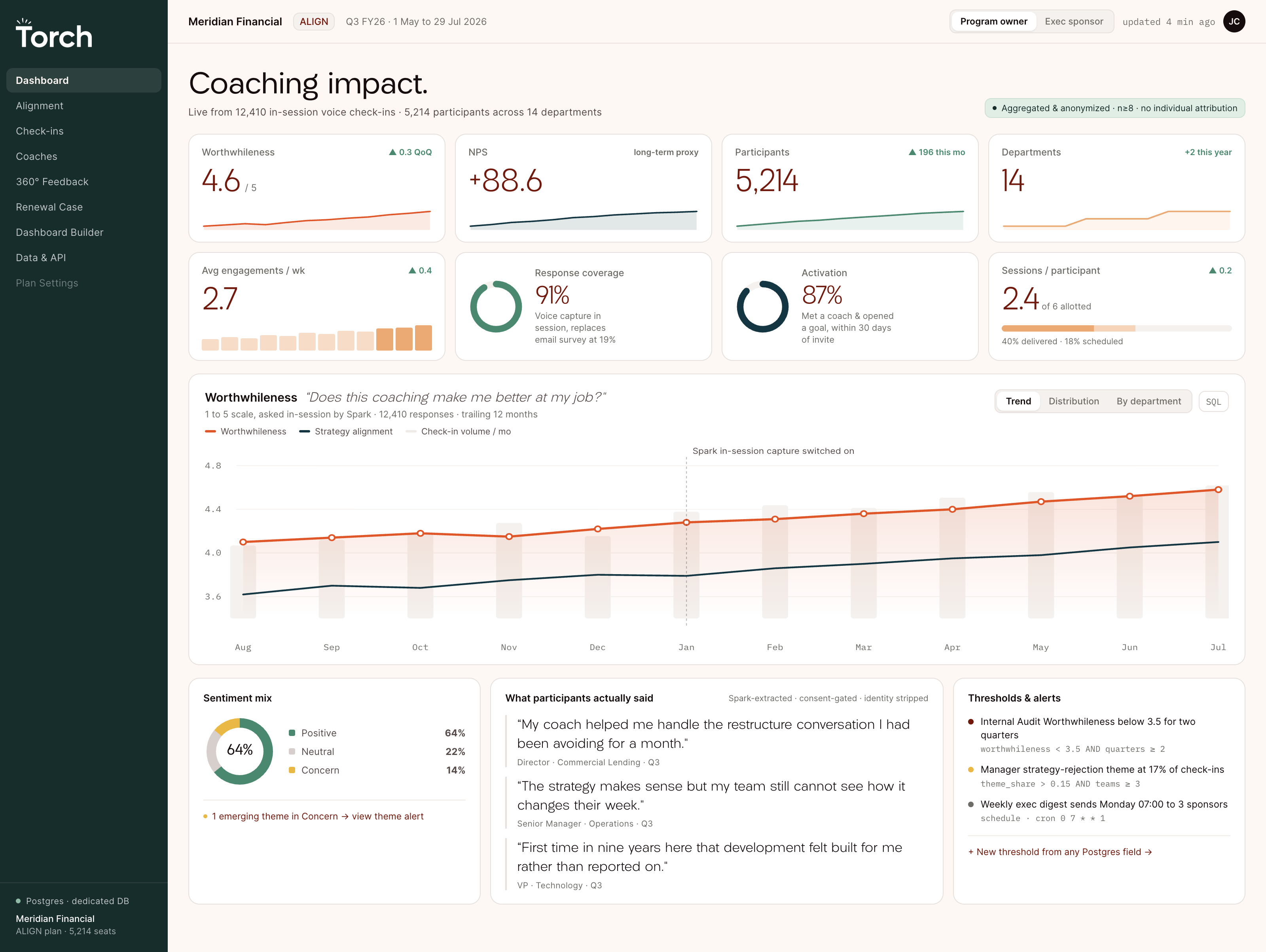
Torch's Worthwhileness dashboard concept is designed to bring participant sentiment, engagement, and program trends into a unified view. For a widespread rollout, this design frames useful questions: Are people participating? Do they find the coaching useful? And where should the program team focus its attention?
 View full size
Programs spanning multiple teams or regions require careful attention to comparability. Different rater groups, translated questions, or inconsistent follow-up can affect your results. A strong overall average might hide a group that received minimal coaching or a region where participants struggled to complete the assessment.
Be clear about the limitations. A 360 change documents what raters report; it doesn't prove, by itself, that coaching caused a business outcome. If retention or productivity matters, define the specific metric and comparison you would need. Treat a financial-return calculation as a separate analysis, not simply a label attached to improved assessment scores.
Resolve the practical details before rollout
Creating a consistent participant experience takes more than platform access. Determine who will invite each cohort, explain the purpose, handle questions, and notice when someone hasn't started. Give local managers a defined role without suggesting they can review confidential coaching conversations.
| Workstream | What to settle before launch |
|---|---|
| Participant access | Eligibility, languages, onboarding and scheduling requirements by cohort. |
| Program operations | Owners for invitations, support, rematching and participation follow-up. |
| Data and reporting | Access permissions, assessment timing and the reports each audience receives. |
| Commercial scope | Human sessions, AI tools, assessments, support fees and renewal terms. |
Review Torch’s security information and CoachHub’s compliance information as references for procurement. Ask for current evidence specific to the services you plan to purchase. For AI, clarify retention policies, model usage, deletion procedures and employer access rights at the product level. Ensure the arrangements for human-coaching sessions and AI practice are both clearly defined.
Standardize your commercial comparison by using the same population and term. Separate human coaching allocation, practice access, assessments and delivery support. A package with broader AI access might serve different goals than a smaller group receiving ongoing human coaching. Neither price indicates which approach will meet your development needs until the scope is clearly defined.
Consider an annual L&D catalogue
Torch’s L&D catalogue lets a buyer commit an annual budget and draw from it for selected services throughout the year. This approach could benefit distributed businesses with varying support needs across teams. Be sure to agree on eligible services, unit prices, booking processes and unused budget treatment before comparing it with a fixed coaching package.
Where Torch and CoachHub make the strongest case
Torch: a coherent program around leadership priorities
Consider Torch when you need experienced human coaches working with agreed leadership capacities and a structured before-and-after assessment. One-coach team engagements focus on collective performance, while the Sponsored Mentoring Program connects rising leaders with executive access and stretch opportunities. Select the formats and practice options that align with your specific needs.
CoachHub: a range of formats for a distributed population
Consider CoachHub when its global network and mix of individual, executive, collective, hybrid and AI offerings match the groups you need to support. Verify the actual language coverage, coach availability and measurement package for your specific rollout. Its extensive options are valuable when you can implement them as a clear experience for each cohort.
Begin with one representative cohort and one significant leadership challenge. Compare what each provider offers for those participants, then expand the program design once the responsibilities, experience and evidence are clearly established.
Frequently asked questions
Is CoachHub only for large international employers?
Its international coach network is relevant to multinational programs, but that is not its only use. CoachHub offers individual, executive, collective, hybrid and AI coaching. Evaluate the formats and delivery commitments that fit your population rather than choosing by company size alone.
How does Torch’s coach standard compare with CoachHub’s?
Torch requires ICF credentials and at least five years of coaching experience. CoachHub publishes professional-certification requirements, a minimum of 500 coaching hours and 10+ years of executive expertise. Coaching hours, coaching experience and executive experience are different measures; review the actual coaches proposed for your leaders.
Can CoachHub combine human coaching with AI?
Yes. Rise is its hybrid offering, and AIMY provides AI coaching and roleplay. For Torch, discuss human coaching alongside optional Spark rehearsal or scored practice from Praxis Labs by Torch. Confirm the specific allocation and tools included in either proposal.
Does Torch support team coaching as well as individual coaching?
Yes. Torch offers individual coaching, peer-group coaching and dynamic team coaching. Dynamic team coaching brings an intact team and its manager together with one coach. Specify whether you want to develop individual leaders, connect peers or change how an existing team works.
What is Torch?
Torch is a leadership coaching and alignment platform for mid-market and enterprise talent teams. Its programs connect experienced ICF-credentialed coaches, company leadership priorities and before-and-after 360 feedback. Buyers can combine individual, group or intact-team coaching with optional AI practice to fit the people and work involved.
Keep comparing with a clear brief.


Become a Torch Changemaker.