
Skip to Main Content

The AI investment paradox

Key Takeaways:

  • Only 46% of workers trust AI systems at work and leaders are the reason that changes
  • Why leadership capacity, not technology, is the real blocker to AI adoption
  • What separates companies where AI works from the ones where it doesn’t
  • Why human skills are becoming more valuable as AI scales
  • How HR is leading the way (and why credibility is the currency)

Corporate America has poured $252.3 billion into AI in 2024 alone. Most companies still can’t point to a single meaningful business result.

The technology works. Employees are using it. But MIT found that 95% of generative AI pilots at companies are failing, and McKinsey reports that fewer than 1% of organizations describe their AI adoption as “mature.”

Massive investment, negligible return.

The real blocker isn’t the technology

Writing in Fortune, Torch CEO Heather Conklin argues that companies are treating AI as a technical problem when it’s actually a leadership capacity problem. “We’re asking leaders to drive massive change without equipping them to do it successfully,” she writes. “Until that gap closes, AI will remain stranded capital.”

The data supports this. A McKinsey report on AI in the workplace concluded that employees are ready for AI, but “the biggest barrier to success is leadership.” C-suite leaders were more than twice as likely to blame employee readiness than to look at their own role.

Meanwhile, Gartner found that 66% of CEOs say their own executive teams lack AI confidence. The people responsible for driving AI adoption don’t feel equipped to lead it.

HR is being forced to reinvent itself

In a recent Business Insider piece, Conklin described how getting workers to both trust and adopt AI has become one of HR’s most urgent challenges. “It’s forcing HR people to reinvent themselves,” she said. “And the ones I see succeeding are the ones who are going first.”

This means HR teams treating their own departments as testing grounds, experimenting with different tools and learning what works before asking the rest of the organization to follow.

“They can’t drive it across the company if they haven’t lived it,” Conklin said. “They need to drive it from a place of credibility.”

That credibility matters because trust is the currency. A Pew Research Center survey found that 32% of workers think AI will lead to fewer job opportunities for them in the long run. A University of Melbourne and KPMG study of over 48,000 people across 47 countries found that only 46% of respondents are willing to trust AI systems at work.

The human skills paradox

While companies pour money into AI tools and technical training, the skills that matter most aren’t technical at all.

Workday’s “Elevating Human Potential” report found that 83% of workers believe AI will make uniquely human skills even more valuable, not less. The skills deemed least likely to be replaced by AI are also considered the most valuable: ethical decision-making, relationship building, emotional intelligence, and conflict resolution.

The more AI automates routine work, the more human leadership capabilities matter.

This creates a gap that most organizations aren’t addressing. Gallup’s 2025 research found that when employees strongly agree their leadership has communicated a clear plan for integrating AI, they’re three times as likely to feel prepared to work with it and 2.6 times as likely to feel comfortable in their role.

Clear leadership communication changes everything. But most leaders don’t have a clear plan themselves.

What the successful 5% do differently

Harvard Business Review analyzed what separates companies where AI pilots succeed from the 95% where they fail. The differentiator isn’t the technology.

The winning companies do two things at once. They fund technical training and they fund developing leadership capacity for transformation. Their leaders can navigate fear and resistance across teams while creating strategic clarity and alignment. They build safety for experimentation and failure, and they model risk-taking in uncertainty.

That requires more than workshops. It requires individualized support for challenging situations. How to have conversations about readiness. How to create psychological safety when someone says they’re afraid of being replaced. How to navigate resistance when it shows up.

As Conklin puts it, “You can’t solve an adaptive challenge with a training program.”

The path forward

Companies are funding the wrong intervention. They’re treating AI as a training gap when it’s a leadership capacity gap.

Workday’s own AI adoption story illustrates what’s possible when you get this right. Their internal program achieved 85% employee adoption within six months by moving away from top-down mandates and focusing on peer-to-peer sharing. Employees demoed their own successful use cases. Leaders modeled curiosity instead of certainty.

At Torch, we’re building tools to help leaders practice these exact conversations. Spark, our AI coaching agent, gives leaders a safe space to rehearse high-stakes moments, from navigating resistance to creating psychological safety, before they face them with their teams.

The companies that get this right will build leadership capacity that outlasts whatever technology comes next.

The billions are already spent. The question is whether they turn into returns or stranded capital. That answer depends entirely on whether you’re willing to invest in the leadership gap, not just the technology gap.

Ready to build your leadership capacity for AI transformation?

What “AI Coaching” actually means (and why it matters)

Overview

The AI coaching market is fragmented, with three distinct models emerging: programmatic chatbots, human coaching platforms, and integrated systems. As 82% of executives plan to adopt AI agents by 2027, understanding these differences is critical. This article breaks down what each approach offers, introduces the International Coaching Federation’s AI Coaching Standards (November 2024) and their 2025 updates, and explains why integrated systems combining human expertise with AI agents deliver the most complete leadership development solution.

KEY TAKEAWAYS

📊 By The Numbers:
82% of executives plan to adopt AI agents within three years (Capgemini, July 2024)
13% of employees use AI for 30%+ of daily work—3x higher than leaders estimate (McKinsey, January 2025)
67% of managers field AI-related questions from teams weekly (AllAboutAI, October 2025) ICF released comprehensive AI Coaching Framework and Standards in November 2024, with ongoing 2025 updates

Core Insight: The leadership development gap isn’t about choosing between human coaching and AI—it’s about building integrated systems where both amplify each other.

If you’ve been shopping for leadership development solutions lately, you’ve probably noticed everyone’s talking about “AI coaching.” The problem? No two people seem to mean the same thing.

Some platforms offer chatbots that answer questions. Others use AI to match leaders with human coaches. A few are building something different entirely—systems where human expertise, AI-powered practice, and organizational intelligence work as one.

The confusion isn’t just semantic. Companies are making significant investments in leadership development, and the differences between these approaches have real implications for outcomes. With 82% of executives planning to adopt AI agents in the next three years, clarity matters more than ever.

Three Models Emerging

The “AI coaching” landscape is sorting itself into three distinct categories, each with different strengths and trade-offs.

1. Programmatic Chatbot Systems
Programmatic chatbot systems use basic conversational AI to provide on-demand guidance through scripted flows and pre-programmed responses. Think of them as automated advisors that can answer FAQs, suggest frameworks from a knowledge base, and offer standardized guidance. They’re accessible and scalable, delivering consistent information when people need it.

The limitation? They follow predetermined paths, can’t adapt to complex contexts, and lack the sophistication to truly understand nuanced situations or hold someone accountable over time.

2. Human Coaching Platforms
Human coaching platforms pair leaders with professional coaches for one-on-one development. These relationships create the psychological safety and personalized support that drive lasting behavior change. Coaches bring lived experience, intuition, and the ability to navigate the messy, human challenges of leadership.

The constraint? Scale and cost; getting expert coaching to every leader who needs it remains difficult for most organizations.

3. Integrated Systems
Integrated systems combine human coaching, AI agents (autonomous systems capable of multi-step planning and execution), and real-time organizational feedback. This is where Torch operates. Leaders work with expert coaches who understand their world, practice new behaviors in realistic simulations, and receive insights tied to actual business context.

It’s not about replacing one with the other. It’s about building a complete system where each element amplifies the others.

What Adaptive Coaching Technology Actually Does

At Torch, we call our AI agent Spark. Spark isn’t a human coach, but it guides you in similar ways—helping you discover your own answers and reach new levels of capability. Rather than simply providing solutions, Spark uses adaptive questioning and practice to help you arrive at insights that stick.

Here’s what that means in practice. Spark creates immersive simulations where leaders can rehearse difficult conversations, navigate high-stakes decisions, and build new capabilities before the pressure’s on. A leader preparing to discuss performance issues with a team member can practice that conversation multiple times, receiving real-time feedback on approach, tone, and effectiveness. Someone learning to lead through change can work through scenarios that mirror their actual challenges—testing different strategies, seeing consequences, building muscle memory.

This is fundamentally different from a chatbot that offers advice. Spark guides you to your own conclusions through adaptive questioning and scenario-based learning. It lets you practice doing it, makes the experience feel real, and helps you develop instincts that transfer to actual leadership moments.

The feedback is adaptive. It adjusts based on choices, builds on coaching goals, and connects to the leader’s specific development areas. And because it’s part of the broader Torch platform, insights from practice sessions inform coaching conversations, and coaching goals shape what leaders practice. Importantly, Spark ingests all the context and background of your teams and business, so it “knows” how to help you navigate organizational challenges specific to your environment.

Standards Are Now Established (And Evolving)

The International Coaching Federation (ICF) released its AI Coaching Framework and Standards in November 2024 and has continued refining ethical guidelines throughout 2025, including specific AI disclosure requirements in its updated Code of Ethics (April 2025). These standards address critical questions: How do we ensure AI systems are ethical? How do we maintain trust and safety? How do we distinguish between AI that supports coaching and AI that attempts to replace it?
These standards matter because they establish a baseline. Not all AI in the coaching space is created equal, and organizations need ways to assess quality, safety, and appropriateness for their needs.

Torch’s approach aligns with these evolving standards by maintaining clear distinctions: Spark complements expert human coaching rather than attempting to replicate it. The AI agent handles practice and skill-building. Human coaches handle the complex, contextual work of transformation.

Why the Distinction Matters

Different approaches solve different problems.
If your goal is to give leaders instant access to frameworks and information, conversational AI can help. If you need leaders to develop the judgment and resilience required for transformation, you need human coaching. If you want leaders to practice new behaviors in safe environments and build lasting capabilities at scale, you need an AI agent like Spark.

The challenge most organizations face isn’t choosing between these options. It’s that they need all three, and most solutions only provide one.

The Leadership Gap Is Real

Research from McKinsey’s January 2025 workplace AI report reveals a significant perception gap: C-suite leaders estimate only 4% of employees use generative AI for at least 30% of their daily work. The reality? 13% of employees self-report this level of usage—three times higher than leadership estimates.
Meanwhile, according to AllAboutAI’s October 2025 workplace research, 67% of managers report fielding questions from their teams about AI tools at least weekly.

Leaders are navigating unprecedented complexity with limited support. They need more than information. They need practice changing their behavior, expert guidance for the hard stuff, and insights that connect their growth to organizational outcomes.

The Integration Advantage

Torch built a leadership development system where human coaching, adaptive practice, and organizational intelligence work together.

Expert Human Coaches: Leaders work with expert coaches who have real leadership experience and understand the challenges they’re facing. These partnerships are grounded in business reality, with coaches who understand the specific context of your organization and industry.

AI-Powered Practice: Between coaching sessions, leaders use Spark to practice. They rehearse difficult conversations, work through decision frameworks, and build capabilities in immersive scenarios. The practice is tied to their coaching goals, so development is continuous rather than episodic.

Organizational Intelligence: The platform surfaces organizational insights that show how individual growth connects to team and company outcomes. Coaches can see patterns across the organization. Leaders can track progress against capabilities that matter. L&D teams can demonstrate ROI.

This is what contextual coaching looks like: development that’s personalized, practice-based, and tied to the real work leaders do every day.

The Both/And Future

The question isn’t whether AI will play a role in leadership development. It already does, and 82% of executives are planning to expand that role significantly.
The question is how we deploy AI responsibly and effectively. How do we use it to amplify human expertise rather than attempt to replace it? How do we ensure leaders get what they actually need—which is rarely just more information?

The companies getting this right aren’t choosing between human coaching and AI. They’re building integrated systems where both play to their strengths. Human coaches for transformation, judgment, and complex challenges. AI agents for practice, skill-building, and always-on support. Organizational insights to connect individual growth to business outcomes.

That’s not “AI coaching.” That’s leadership development redesigned for how work actually happens.

Want to see how it works?

Watch the Spark demo video and request a customized demo for your organization.

Sources & References

Primary Research:
Capgemini Research Institute. “Unlocking the Value of Generative AI.” July 2024.

McKinsey & Company. “Superagency in the workplace: Empowering people to unlock AI’s full potential at work.” January 2025.

AllAboutAI. “60+ AI Statistics in Workplace: 2025 Trends and Predictions.” October 2025.

Industry Standards:
International Coaching Federation. “ICF Artificial Intelligence (AI) Coaching Framework and Standards.” November 2024.

International Coaching Federation. “What’s New in the ICF Code of Ethics (Effective April 1, 2025).” April 2025.

What is Spark? A guide to Torch’s AI coaching agent

Key takeaways:

  • Spark is Torch’s always-on AI coaching experience
  • Spark adapts to your organization’s context, tying guidance to your specific goals and challenges
  • A built-in 360 shows leaders how they’re showing up
  • Rehearse high-stakes moments and get real-time feedback
  • Can be used with or without a coaching engagement

Intro

Most leadership training doesn’t work. People learn something in a workshop or coaching session, and within a week, 75% of it is gone. Not because leaders aren’t motivated, but because there’s no place to practice before it counts.

Spark is Torch’s always-on AI coaching experience. It gives leaders a place to work through challenges, prepare for tough conversations, and build leadership capacities that actually stick. And unlike generic AI tools, Spark learns your organization’s priorities, values, and leadership expectations, then builds on what it knows about each user over time.

Grounded in your context

Generic AI coaching tools treat every user the same regardless of role or goals.

Spark is different. It grounds every conversation in your organization’s leadership capacities, values, priorities, and expectations. And it builds a memory of each user: their role, their challenges, their goals, and patterns that emerge over time.

As leaders engage, Spark develops an understanding of how they show up in their role, what they’re navigating inside the organization, and where progress and friction tend to emerge. A first-time manager preparing for a performance conversation gets different support than a senior leader navigating a restructuring.

This is coaching grounded in your reality, not a library of generic prompts.

Practice for the moments that matter

Research shows only 10% of leadership training produces meaningful behavior change. You learn something in a session, then struggle to apply it when the pressure’s on.

Spark solves this by letting leaders practice before the stakes are real. You rehearse tough conversations with a realistic AI character who responds based on how the conversation unfolds. Spark coaches you on the side with real-time feedback. Preparing to give tough feedback to an underperforming team member? Practice it first. Navigating resistance to a transformation initiative? Work through the conversation multiple times, testing different approaches.

These aren’t scripted interactions. The AI character adapts in real time to how you engage with it; a manager who hesitates will experience different responses than one who takes a direct approach. The scenario shifts based on your choices, so the practice feels real.

Afterward, you get a clear breakdown of what landed, what didn’t, and what to try next.

See how you’re showing up

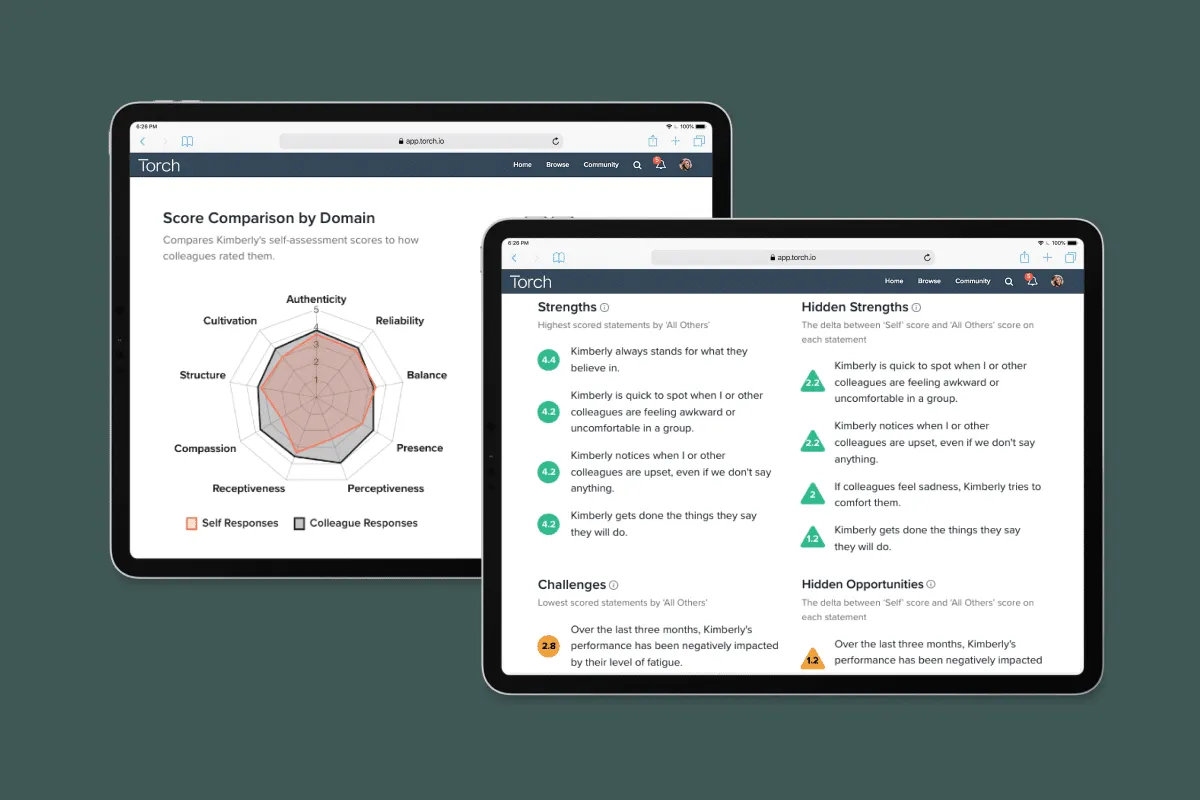
Spark can also include a 360 so leaders can hear directly from the people they work with. We partner with your organization to define the leadership capacities that are most aligned with your business goals and values, things like adaptive mindset, learning agility, and trust building. Then managers, peers, and direct reports weigh in on how that leader is showing up.

After the 360 is complete, the results feed back into Spark, so when a leader practices a tough conversation or works through a challenge, Spark already knows where they’re strong and where they’re still growing. And, admins get a separate report that surfaces patterns across the organization, creating powerful data.

Feedback that builds capacities

The feedback isn’t generic advice. Spark provides a personalized breakdown of what your responses signaled, how your behaviors aligned to leadership standards, and specific strategies for strengthening your impact.

This is fundamentally different from a chatbot. Spark guides you to your own conclusions through adaptive questioning and scenario-based learning. It helps you develop instincts that transfer to real leadership situations.

Connected to coaching (or powerful on its own)

Spark is designed to integrate with human coaching, but it doesn’t require it.

When paired with coaches, Spark creates a continuous feedback loop. As you engage in conversations or with AI role-plays, patterns surface about where you’re gaining confidence and where you’re still stuck. You can share those insights directly with your coach, so they can adjust their approach, go deeper on barriers, and reinforce what’s working.

Human coaches handle the complex, contextual work of transformation while Spark handles practice and strengthening skills that ladder up to big-picture leadership capacities. DDI’s 2025 Global Leadership Forecast found that organizations using five or more development approaches are 4.9 times more likely to report that their programs actually improve leadership capabilities. Spark adds a critical layer most programs are missing.

When used on its own, Spark gives every employee access to meaningful development conversations, anytime, anywhere. Gallup’s 2025 State of the Global Workplace reports that less than half of managers worldwide have received any management training, and Spark closes that gap. Leaders who don’t have dedicated coaches can still rehearse tough conversations, get personalized feedback, and build capabilities tied to organizational goals.

For a deeper look at how AI coaching and human coaching work together, see our P.O.V. on what it means to combine human and AI capabilities.

Who Spark is for

Spark works for organizations rolling out transformation initiatives and for individual leaders who need support between coaching sessions.

At the org level:

  • Companies undergoing AI adoption, M&A, or restructuring
  • L&D teams looking to scale development beyond those with dedicated coaches
  • Leaders who need to extend growth opportunities to more team members

For individuals:

  • Leaders at all levels preparing for high-stakes conversations
  • Individual contributors navigating change
  • Anyone between coaching sessions who needs practice or guidance

What makes Spark different

Most AI coaching tools are transactional. You ask a question, you get an answer, and nothing connects to what happens next. There’s no memory of your goals, no awareness of your organization’s priorities, and no way to tell whether anything actually changed.Spark works differently.

Your practice sessions build on each other, and feedback ties directly to your development areas and organizational context. Instead of measuring how often you logged in, Spark tracks whether your behaviors are shifting. Organizations that embed systematic coaching record 25% stronger business outcomes than their peers, and Spark brings that rigor to AI-powered development.

Privacy and security

Research shows that 56% of monitored employees report stress or tension at work. When people don’t trust how their data is being used, they hold back.

Spark is built differently. All coaching conversations are private and confidential. Individual-level data is never shared with employers or managers, and organizations don’t have access to raw conversations.

What organizations do see are themes and trends across the user base, not individual coaching data. This surfaces patterns that can inform leadership development strategy without compromising trust.

Spark does not use customer data to train our models or any third-party AI models. Data is used only to deliver the coaching experience, and Spark is designed to meet enterprise security and privacy expectations.

See it in action

Spark turns leadership development into continuous growth. Curious how Spark works?

Watch the demo

5 types of leadership transformation that will change your business

Every year, we ask our coaching participants two questions: what actually changed, and did anyone else notice?

The patterns were striking. The same five shifts kept showing up across industries, roles, and seniority levels. These were the ones participants named most often.

1. From doer to force multiplier

Most leaders got promoted because they were excellent at fixing things. But at a certain point, being the answer to every question becomes a bottleneck.

The shift: stop solving, start building the people who solve.

One participant described it this way: “Thinking like a director means focusing on the what, why, and when while allowing my team to focus on how. Shifting from a hero mindset to a leader mindset will unlock my ability to grow.”

The result: Teams start moving without waiting for answers. Less reliance on any single person. The bench gets deeper.

2. Decision-making clarity in shifting environments

Change tends to produce two reactions. Rush and regret, or endless deliberation. Neither moves the organization forward.

The change: pause long enough to see the bigger picture, but move before you stall.

One leader put it simply: “I can make faster decisions with the aim of making progress as opposed to spending time thinking things over too much. Coaching has helped me step back and consider the bigger picture before diving into action.”

The result: Projects keep momentum. Fewer reversals. Leaders become known for calls that hold up over time.

3. Reducing “organizational drag” 

Every organization accumulates friction, unspoken expectations, feedback that never landed or conversations that should’ve happened months ago.

The transformation: address misalignment directly instead of working around it.

As one participant shared: “I’ve learned to provide more specific feedback and task clarity without fear of being a micromanager. Our relationship is now more open, aligned, and productive, which has elevated how I lead.”

The result: Stalled projects get unstuck. Cross-functional handoffs stop breaking down. Performance issues get addressed before they spread.

Restructures. Role changes. Reorgs. The leaders in our programs weren’t navigating hypotheticals.

The reframe: treat change as a signal to update your approach, something to work with instead of against.

One leader described it: “I’ve learned to reframe how I present and manage change, seeing it as an opportunity for progress. I’ve developed the ability to put things into perspective, allowing me to navigate challenges with focus and balance.”

The result: Transitions land faster. Teams stay productive through uncertainty. Less friction when priorities shift.

5. Risk mitigation and culture stabilization

Stress at the top bleeds downward. When leaders are reactive or scattered, their teams feel it.

The discipline: regulate your response before it regulates the room.

One leader explained: “I can slow down and breathe instead of a quick negative reaction. I can control myself and have a more positive impact. Sticking to facts lowers the electricity in tense environments.”

The result: Fewer fires caused by overreaction. Teams stay focused instead of anxious. Hard conversations happen without drama.

What makes these transformations last

Skills get learned and forgotten. Leadership capacities work differently. They reshape how you see, decide, and show up. And they compound.

The first two draw on systemic intelligence, seeing patterns and making confident decisions in complexity. The third and fourth rely on collective leadership and self-evolution, building trust while staying grounded through change. The fifth is pure self-evolution: leading with clarity even when things get loud. All of them feed into transformative impact, growth that shows up in the business, not just the leader.

When these capacities strengthen, the growth doesn’t stay with one leader. It ripples outward into teams, projects, and how the whole organization moves.

Want more leaders like this in your organization? See how we do it.

Been there, led that: Why lived experience makes better coaches

I have always considered myself someone who excels at understanding models and frameworks. I’ve built my career on being “good with people.” Yet there was a moment in my leadership journey when I found myself overwhelmed, standing in a fog so thick I couldn’t see the path forward.

I was living in a state of high stress, putting immense pressure on myself. Leaders today must simultaneously hold so much—care for their people, strategic thinking, delivering results—all while weathering constant change. In that moment, I couldn’t meet my own high standards in any of my roles.

That turning point came when I sat across from a coach who had held the weight of leadership themselves. They looked into my eyes and said, “I understand, I’ve been there myself.” In that moment of recognition, something shifted. This wasn’t about theory—it was about human connection with someone who could help me put one foot in front of the other.

When you’ve walked the path, you guide differently

That early experience sparked something in me. Over the years—and now as Torch’s Director of Coaching Experience— I’ve observed what makes the difference between coaching that feels like just another conversation and coaching that fundamentally shifts how leaders show up in the world.

Leadership happens in the messy middle of competing priorities, limited resources, and high expectations. Coaches who have been leaders themselves bring a different foresight and understanding than those who have never led people. Our coach-leaders understand your unique context and work culture to help steer you toward what would actually work in the world you’re in—not some theoretical ideal.

“I was expecting a hard-nosed football coach who would point out all my flaws and demand greatness. Instead, he listened intently with the goal of understanding my position, and then worked with me to find solutions.”—Gregory S., Financial Leader, Torch Coachee

They carry experience won from mistakes and lessons learned the hard way. They know where to push and probe to help you avoid the big missteps they’ve already made. And when you do stumble—because we all do—they know exactly how to pull those learnings out, because they can see the future application those hard-won insights will have down the line. Their guidance is rooted in the soil of lived reality, not just coaching concepts.

This is why at Torch, we’ve taken a fundamentally different approach to coaching, starting with who we bring into our coach community. We’re incredibly selective, prioritizing coaches with extensive business leadership experience alongside professional accreditation.

We believe great coaching comes from people who’ve truly been there—leaders who’ve navigated complexity and grown through lived experience. Because the wrong coach doesn’t just miss the mark—they can quietly reinforce patterns that hold people back. And when time is one of the biggest barriers to coaching, every moment needs to matter.

Coach today for a better tomorrow

The traditional approach to leadership coaching puts all the onus on the individual to start their coaching journey with an idealized vision for their future. At Torch, we recognize there are three voices in our coaching engagements: the company sponsoring the coaching, the leader being coached, and the coach themselves.

Our active guide approach starts right here, right now: Who are you? What’s going on? What are you struggling with? At the same time, we’re focused on helping leaders grow in ways that align with how their company defines leadership and measures impact—whether that’s through business outcomes, behaviors, or both.

This philosophy of “coach today for a better tomorrow” drives everything we do. We focus on creating immediate improvements, removing obstacles right now, and then layering up lessons for lasting impact. It’s not about chasing some perfect version of the future—it’s about building momentum through real progress that adds up over time.

“Our approach to coaching is actually different. We coach in context, and our coaches act as active guides. It’s not just sitting there asking questions and taking you on your own wild adventure. It’s directed, it’s taking you somewhere, and it’s solutions-focused – helping you find what will make this week better for you and your team.”—Heather Conklin, Torch CEO

Finding guides who’ve walked in your shoes

Because our coaches have lived leadership experience, they have an arsenal of tips, anecdotes, and personal stories that they can offer leaders who are struggling. Our coaches aren’t telling them what to do, but they’re providing tools and options that leaders can pull from to keep moving forward.

This approach is particularly powerful for those new to coaching. We’ve designed our process to remove the trial and error that often makes first-time coaching experiences less productive. Our coaches create trust quickly, establish momentum early, and deliver value from the very first session.

What makes our coaching community exceptional flows from four essential qualities:

  • Deep business experience across varied terrain: Our coaches have led teams, managed complex projects, navigated organizational politics, and delivered results in real business environments.
  • A history of developing others: Beyond their own leadership journey, our coaches have helped others grow, whether as mentors, managers, or dedicated coaches.
  • The balance of challenge and support: Rather than taking a passive approach, our coaches act as partners who provide both empathetic understanding and constructive challenge.
  • Commitment to observable transformation: Our coaches focus on creating real, observable change – not just interesting conversations. They help leaders translate insights into action.

Expanding capacities, not just teaching skills

Our recent Leadership Evolution survey revealed a troubling disconnect: while 74% of organizations know they need to evolve their leadership capabilities, nearly half haven’t made meaningful progress. Many leaders feel unprepared for today’s challenges, with only 32% feeling “pretty prepared” to tackle demands like AI adoption and rapid change.

I see this gap every day in my conversations with leaders. There’s a yearning for development that goes beyond theory – for guidance that truly helps them with what they are up against. Even people who see good leadership around them, have to learn how to internalize these behaviors and make them their own – otherwise, they just mimic their role models and wonder why when they do the same things they don’t have the same results.

This echoed my own experience. In my moment of overwhelm, my cup was already overflowing—nothing could stick or shift. What I really needed was a bigger cup.

Our aim isn’t just to teach leadership skills but to expand fundamental leadership capacities—helping them develop resilience, manage uncertainty, and hold complexity with grace. The bridge between knowing and being is built through relationship—through working with someone who can help you integrate leadership wisdom into your unique context.

Leadership coaching, reimagined

In a world where many coaching platforms are moving toward AI coaching and digital-first approaches, we’re doubling down on the human element of coaching – while using technology to enhance, not replace, the coaching relationship.

Our coaches are more than just skilled questioners – they’re trusted partners who help leaders navigate complexity. We invest heavily in relationships with our coaches. They aren’t vendors; they’re collaborators who help us shape the coaching experience through continuous feedback loops and shared learning.

I’m not just a coach—I get coached too. One of my coaches told me once, “Magic is a shift in perception—change the way you see things and the things you see will change.” I know this may sound fluffy, but when you have the right coach as your guide, they stand with you, challenge your perception, and help you see things in a whole new way.

The moments that have transformed my leadership have also changed me as a person—and that comes from my coach being able to both honor who I fundamentally am and challenge me to uplevel not just my skills but how I think, act, lead, and exist in this hyper-change world.

When you find this kind of guide—someone who’s walked through similar fires—suddenly you’re doing things you never thought possible. How you exist in your world of work has monumentally changed, not just for you but for everyone you work with.

That’s the difference leadership-informed coaching makes. And it’s the Torch difference today’s leaders deserve.

Ready to experience the difference Torch coaches can make? Let’s talk about how our coaches can help your leaders thrive.

Author spotlight

Headshot of Kathryn Coyle, Director of Coach Experience, Torch
Kathryn Coyle, PCC
Director of Coaching Experience
Kathryn Coyle, PCC
Director of Coaching Experience

Kathryn is a longtime coach, mentor, and guide to leaders navigating real-world complexity. With a background spanning entrepreneurship, operations, and leadership development, she brings lived experience and deep empathy to every coaching conversation. She’s passionate about helping leaders grow in self-awareness, resilience, and impact. Her north star? Leadership that feels as human as it is effective.

What to look for in a coaching provider

Not all coaches—or coaching platforms—are created equal. Here are a few signs you’re in good hands:

  • Real leadership experience (not just vague titles)
  • Transparent vetting, including references and tenure
  • Matching based on business context, not just personality
  • Alignment with your company’s culture and leadership goals
  • Focus on outcomes that go beyond satisfaction scores
  • Ongoing development and insight-sharing among coaches

What is laissez-faire leadership?

Leadership is evolving—and with it, our understanding of how best to inspire, empower, and drive teams forward. Today, one leadership style that continues to capture attention is laissez-faire leadership.

But is it still relevant in today’s dynamic, fast-changing workplace? Let’s explore this hands-off approach and how you can make it work with a little help from Torch’s contextual coaching approach.

What is Laissez-Faire Leadership, really?

Laissez-faire leadership takes a step back, empowering team members with the freedom to make their own decisions. Leaders provide the right resources and context but let their teams drive the day-to-day decisions.

This approach thrives in creative, innovative environments—think startups or creative teams—where independent thinking is highly valued.

Key characteristics of laissez-faire leadership:

  • Empowered delegation—trusting teams to make their own decisions.
  • Deep trust—confidence in the abilities and expertise of team members.
  • Strategic distance—knowing when to step in and when to step back.
  • Big-picture perspective—focusing on vision, not micromanagement.
  • Recognition and motivation—celebrating and rewarding independence and success.

But here’s the catch…

Like any leadership style, laissez-faire isn’t foolproof. It can lead to:

  • Lower productivity if teams lack clarity or direction.
  • Confusion around roles, responsibilities, and accountability.
  • Increased conflict if communication and boundaries aren’t clear.
  • Challenges with teams needing guidance or development.

The trick isn’t to abandon laissez-faire entirely, but to adapt it thoughtfully for your context—exactly what Torch coaching is designed to help you achieve.

It’s time for leadership development to evolve. Explore contextual coaching and discover how to make real change happen.

Making laissez-faire leadership work: The Torch way

Laissez-faire doesn’t mean leadership without responsibility—it means leadership that’s intentional, insightful, and adaptable. Here’s how you can integrate Torch’s contextual coaching to avoid common pitfalls and amplify the benefits of laissez-faire leadership:

Align the right people and context  

Hands-off leadership requires capable hands. Torch coaches partner with you to assess your team’s capacities and readiness for autonomy. Our contextual coaching ensures leaders and teams share a clear understanding of roles, goals, and expectations from day one—laying the groundwork for genuine empowerment.

Stay connected without micromanaging  

Taking a step back doesn’t mean losing sight of your team. Torch coaches help you practice active observation—spotting patterns, identifying opportunities, and knowing exactly when to step in. By integrating continuous insights from coaching sessions, you maintain visibility without stifling autonomy.

Navigate complexity with confidence 

Today’s leaders face constant shifts and disruptions—from emerging technology to evolving team dynamics. Torch equips leaders with the adaptive capacities and systemic thinking needed to spot challenges early, ensuring laissez-faire leadership fosters innovation rather than confusion.

Keep feedback flowing

Feedback isn’t about micromanagement; it’s about meaningful growth. Torch’s continuous learning loop means you’re always plugged into what’s happening without stifling independence. Coaches capture insights from sessions, helping leaders reinforce positive behaviors, address issues quickly, and sustain clarity and alignment.

The Torch difference: Evolving leadership for a changing world

At Torch, we know the old one-size-fits-all approaches don’t cut it anymore. Our coaches don’t just help you delegate—they help you do it strategically, creating space for autonomy that accelerates your team’s growth and your organization’s evolution.

Today’s laissez-faire leadership isn’t about stepping away—it’s about stepping back strategically, with clarity, confidence, and context.

Ready to see how contextual coaching can enhance your laissez-faire leadership style? Let’s talk.

There’s coaching. And then there’s Torch. Discover the difference.

What is charismatic leadership?

In a rapidly evolving world, charismatic leadership isn’t just about charm—it’s about genuine connection, authentic communication, and adaptive leadership that resonates with people and drives real change.

Here’s how Torch’s contextual approach helps you amplify the strengths of charismatic leadership while avoiding its common pitfalls.

What is charismatic leadership?

Every leadership style spotlights something different. Democratic leaders nurture teams. Bureaucratic leaders maintain structures. And charismatic leaders? They shine a light on inspiring connection through their own unique presence and communication style. 

What makes a leader charismatic today?

Traditionally, charismatic leaders were known for their charm and persuasiveness. But in today’s world, charisma goes deeper—it’s about:

  • Authentic connection: Leaders who aren’t afraid to show vulnerability build stronger bonds.
  • Relatable optimism: Inspiring belief in what’s possible, even when the path ahead isn’t clear.
  • Engaging storytelling: Sharing real stories, not just polished speeches, to motivate teams.
  • Adaptable confidence: Leading confidently through uncertainty, adapting with empathy, and courage.

Charismatic vs. transformational leadership: What’s changed?

While charismatic leadership emphasizes personal charisma, Torch coaching reveals the importance of aligning personal influence with organizational context. Transformational leaders inspire through vision; modern charismatic leaders combine their personal presence with deep understanding of their organization’s culture and goals.

Pros and cons: A fresh take

Charismatic leadership can uplift teams and foster connection—when applied thoughtfully. But it can backfire when leaders lose sight of their team’s needs.

Pros:

  • Inspires authentic collaboration and engagement.
  • Accelerates positive change with genuine enthusiasm.
  • Builds trust through empathy and openness.

Cons to watch for:

  • Risk of focusing too heavily on personal presence over collective impact.
  • Potential to appear insincere or overly polished if not authentically engaged.

It’s time for leadership development to evolve. Explore contextual coaching and discover how to make real change happen.

How to practice charismatic leadership—Torch style

1. Lean into vulnerability

Forget perfection. Authentic charisma thrives on openness. Show your team your real experiences—challenges and all. Torch coaches help leaders embrace their whole selves, fostering deeper trust and genuine relationships.

2. Listen actively (for real)

Charisma isn’t just about being heard; it’s about making others feel heard. Practice active listening in every interaction. Your team notices when you remember what’s important to them.

3. Lead transparently

Inspire trust by sharing the full picture, not just what sounds good. Torch coaching emphasizes transparency as essential—leaders who communicate honestly build resilient teams prepared to adapt and thrive.

Why contextual coaching makes the difference

Torch’s approach to coaching helps charismatic leaders go beyond charm to build lasting leadership capacities. Our expert coaches provide tailored insights tied directly to your unique organizational context, ensuring your influence aligns with business goals and delivers measurable impact.

Torch coaching in action

Charismatic leadership works best when paired with strategic insight, empathy, and adaptability—core capacities Torch coaching develops. Here’s how we make it real:

  • Adaptive capacity: Leaders become nimble enough to pivot, harnessing their personal influence to guide teams through uncertainty.
  • Human connection: Charismatic leaders build genuine bonds rooted in trust and empathy, fueling collective growth.
  • Systemic intelligence: Leaders develop the skill to see the bigger picture and recognize how their personal style impacts organizational culture and effectiveness.
  • Innovation readiness: Charisma paired with innovation creates environments that encourage creative problem-solving and forward momentum.

Leadership that evolves as fast as the world

Leadership today isn’t static—it’s dynamic and responsive. When charismatic leaders tap into contextual coaching, they amplify their natural strengths—unlocking authentic influence that inspires teams and drives real change.

At Torch, we’re redefining charismatic leadership—not as a one-dimensional trait, but as a multi-layered capacity to connect, inspire, and drive strategic impact.

Discover how contextual coaching can unlock charismatic leadership that matters. Let’s talk.

There’s coaching. And then there’s Torch. Discover the difference.

Succession planning examples and best practices

Want more great resources on people development?

As CEO turnovers continue to hit record highs, most organizations can expect to deal with leadership changes. 

A leadership exit can disrupt any organization – from stock prices taking roller-coaster rides to employees feeling unnerved about ongoing changes. Fortunately, a solid succession plan can turn any exit into a smooth, well-managed transition. 

In this post, we’ll provide best practices to keep in mind for succession planning and share examples of successful leadership transitions.

Top 3 best practices for developing a succession plan

A seamless leadership transition doesn’t happen overnight. That’s why a key part of succession planning is being able to think ahead at least three to five years. Here are four best practices to help you stay ahead of the curve. 

1. Cultivate a pipeline of talent early

Building a high-quality talent pipeline is a challenging and time-consuming process. In fact, 74% of public and 52% of private companies reported that maintaining a robust talent pipeline is the most difficult aspect of CEO succession planning. 

Unfortunately, the pipeline is something that many HR teams tend to neglect. 40% of companies report not having a single internal candidate to replace the CEO should he or she exit the position. This puts the company in a vulnerable position and will ultimately cost the company in several ways, from paying for executive search costs to seeing turnover amongst high-potential employees (HiPos) who feel overlooked for leadership positions.

That’s why, even though you might not have any open positions now, it’s important to start cultivating that pipeline today. This means accurately identifying who your HiPos are and making sure you’re constantly adding new candidates into the mix. 

Want to learn how to identify, retain, and develop the HiPos in your organization?

2. Prioritize key positions and skills

Not all roles need a succession plan. Start by pinpointing the key positions within your organization that are critical to its success. These roles tend to have a significant impact on strategy, operations, and culture.

It’s also important to consider the strategic direction of your company. In the broader landscape, what environment will the company operate in? What are the company’s future goals, and what type of leader will help reach them?

After identifying key roles, break them down into the specific skills and competencies required to excel in them. When it’s time to focus on leadership development, you’ll have a clear understanding of the core skills and areas of growth your talent pool needs to cultivate.
Succession planning: leadership competencies map

3. Identify high-potential leaders

Identifying high-potential leaders requires a blend of observation, assessment, and nurturing.

Begin by assessing leaders who consistently achieve exceptional outcomes. Use tools such as performance reviews, 360-degree feedback, and leadership evaluations to understand their capabilities. Additionally, engage in ongoing discussions with leaders to understand their ambitions and aspirations. Those who display a willingness to learn and grow often indicate future leadership potential.

Equally crucial is pinpointing candidates who “walk the walk” when it comes to your organization’s values. These leaders consistently incorporate these values into their daily work, as reflected in their actions and decisions.

Plus, here’s two bonus best practices you should add to your list:

1. Invest in the ongoing development of leaders 

Identifying high-performers is just the beginning; providing ongoing leadership development to ready them for future roles is crucial. In practice, this means helping HiPos develop relevant leadership skills, align with the company culture, and have opportunities to be exposed to various roles and responsibilities.

On the surface, companies invest a lot of resources in training their leaders. A Training Industry study found that organizations around the world spend $370 billion per year on leadership development. Yet 74% of executives were not prepared for the challenges they faced in senior leadership roles. This indicates a gap between the type of training that’s being provided and the intended effectiveness. 

We’ve found that relationship-based development — like coaching and mentoring — is the most effective approach for leadership development. Not only are mentoring and coaching the two most unmet needs of HiPos, but 86% of companies report that they recouped their investment in coaching and more.

Moreover, research shows that relationship-based development, like coaching, is more effective at helping leaders develop new skills than traditional skill training, with 87% of leaders ranking coaching as “very to extremely effective” at skill development.

2. Regularly monitor and assess your leadership bench 

Once you’ve gone through the process of appointing a new leader, you may feel like the job is over. Yet, organizations and people are constantly evolving, making it essential  to regularly monitor and assess your leaders. This process ensures the HiPos leaders in your pipeline are still aligned with the needs of your company. It can also help you identify any new or rising HiPo leaders you may have missed in your initial assessment. 

For example, you may have identified a promising HiPo leader in your talent pipeline. But, after a few years at your organization, it’s evident that they’re not growing in the direction that you anticipated. Without regularly assessing this individual’s performance, you wouldn’t be able to identify that they’re no longer a good fit for the executive position they were originally being considered for. And you may be passing up a better fit for the role in the process. 

4 examples of succession planning in real life

Given the public nature of leadership transitions, we’ve seen many succession plans in action. While not all of them go as smoothly as anticipated, some companies do an excellent job of putting the best practices we outlined above into practice. 

Johnson & Johnson

Peter Fasolo, the Chief Human Resource Officer at Johnson & Johnson, has overseen two major leadership transitions at the company. The first, in 2012, when then-CEO Bill Wheldon decided to move on and was eventually succeeded by Alex Gorsky. Then, a decade later, in 2022, when Grosky decided to serve as Executive Chairman, leaving the CEO role vacant. 

In both transitions, Fasolo followed the same framework for identifying the ideal candidate. First and foremost, he evaluated the broader environment in which the new CEO would be working in. He considered current events that might impact new market opportunities, as well as the strategic direction of the company.

Fasolo also leveraged Johnson & Johnson’s Credo — the company’s 80-year-old value statement — to craft a CEO profile. This served as a guiding tool, helping him identify candidates who aligned with the company’s core values.

What Johnson & Johnson did right:

  • Tied succession planning to the strategic direction of the company
  • Prioritized leaders who aligned with the company’s core values
  • Performed regular talent reviews

McCormick & Co.

In 2008, spice and flavorings giant McCormick & Co. transitioned its CEO position from Robert Lawless to his successor Alan Wilson using a succession model that was praised for being thoughtful, comprehensive, and well-executed. Lawless made a point of establishing a transparent timeline of five years, planning his transition to a non-executive chairman of the board role. He also tied part of his discretionary compensation to succession planning, proving his investment in finding and preparing the right person. 

What McCormick & Co. did right:

  • Developed its own robust succession planning over the course of many years, taking its time to intentionally identify and create thorough development strategies for all senior executives
  • Monitored the progress of its potential candidates over several years before settling on Wilson, who demonstrated a strong fit with the company culture and a deep understanding of front-line issues

IBM

Virginia Rometty’s succession as CEO of IBM in 2012 is also a case of internal succession planning done well. Rometty’s advancement worked well because of her cultural fit, and because of the professional development systems that allowed her to succeed based on merit and become IBM’s first female CEO. HR analyst Josh Bersin said of Rometty’s appointment: “IBM’s talent management process is very mature, integrated, and global. At the executive level, the company takes development planning and succession very seriously.” 

What IBM did right:

  • Rometty started at IBM as a systems engineer, eventually climbing the ranks upward to SVP and Group Executive for Sales, Marketing, and Strategy before being offered the CEO role
  • She’s a prime example of an incoming CEO who was well-entrenched in the company culture, known to the board, and had a sterling track record

Barneys New York 

Luxury retailer Barneys New York went through a long-planned change as Daniella Vitale stepped into the CEO role in 2017, replacing her predecessor and mentor Mark Lee. With her long tenure in the high-end fashion retail industry, Vitale was considered “uniquely qualified” to run Barneys. She worked as an assistant buyer while still in school at LIM College and moved her way up through lateral moves between major brands, including Ferragamo, Armani, and Gucci, before joining Barneys in 2010 as a Chief Merchant.

What Barneys New York did right:

  • Vitale was given substantial leadership opportunities and had experience running nearly every facet of the organization by the time she was offered the CEO position 
  • Lee spent a long time investing in Vitale’s success, and he was instrumental in putting together a formal five-year succession plan specifically for her

Back to You

Succession planning is a long and laborious process. But done right – by cultivating a high-quality talent pipeline, developing your HiPo leaders, and regularly assessing fit – it can make an otherwise stressful transition much smoother.

Want to learn more about how to identify and develop the HiPos in your organization?


Does Executive Coaching Actually Work?

Want more great resources on people development?

Today, executive coaching is everywhere. But is it effective? In this article, we pull back the curtain on coaching: the good, the bad, and the questions you should be asking.

Think back to the early days of your career. There were plenty of opportunities to learn, right? Maybe it was by trial and error (who doesn’t have that one specific memory of making a huge mistake at their first “real” job that they vowed never to repeat again?). Or maybe you were lucky enough to find a mentor who imparted sage advice and answered every seemingly silly question you had. For most of us, there was plenty of grace and guidance available as we learned to move through the world of work.

But as professionals climb the corporate ladder, that feeling becomes more rare. Employees become managers and managers become executives, and while the challenges don’t dwindle, the number of people who can empathize and help solve the unique problems that emerge at each stage does.

This is where executive coaching comes in: a one-to-one engagement in which an executive enlists a coach to help them look inward, address specific challenges, and ultimately become a better leader. But does it work?

Today, executive coaching is a practice that’s as ubiquitous as it is secretive. In 2023, the International Coaching Federation observed a 21% increase in global coaching revenue over a four-year period that began in 2015, putting the total in 2019 at $2.849 billion—a number that’s only grown since. But what actually goes on in executive coaching sessions? These engagements are highly personalized, often protected under NDA, and largely occur behind closed doors.

So today, let’s shed some light on executive coaching. At Torch, we believe that it can be transformative—not just for leaders, but also for their teams. But it’s only as effective with a highly skilled coach, and an invested participant.

In this article, we’ll explore what good (and bad) executive coaching looks like and how to assess whether a coach is a good fit for you.

What good coaching looks like

While every coaching experience looks different, effective coaching tends to have a few key commonalities.

  1. It’s provided by a certified coachPerhaps this one should go without saying, but we’ll say it anyway: Please do not hire an executive coach who isn’t certified. Accreditation has become more widespread over the years—the International Coaching Federation has accredited over 25,000 coaches—but this number is dwarfed by the estimated five million plus ‘coaches’ that are operating worldwide.Certified coaches have the requisite education and experience (a minimum of 300 hours!) to guide their coachees, and because coaching is an investment, you want to be able to say it was worth it.
  2. It’s forward-lookingAn effective leader guides their organization towards the future. Similarly, good executive coaching keeps a leader’s gaze on the horizon. To the untrained eye, executive coaching may look an awful lot like psychotherapy rebranded for the workplace. But as “The Clear Coach” Dr. Rakish Rana writes in Forbes, there are distinct differences: Psychotherapy tends to look backward at the participant’s past, while great executive coaching looks forward.
  3. It encourages introspectionWhile executive coaching is not the same as psychotherapy, it does require the participant to go inward. As business writer and executive coach Erika Andersen—who has coached execs at Amazon, Spotify, CBS, and more—writes in Forbes, “Accurate self-awareness in leaders is highly correlated with organizational effectiveness and profitability, and employees prefer to follow leaders who see themselves clearly.” By creating a dynamic wherein the leader feels safe to address their own insecurities and self-image without judgment, effective coaches foster an environment where the leader can be truly introspective—which in turn empowers them to build trusting relationships with their teams.
  4. It’s tied to performanceHow does a leader know that they’re getting any better at leading? Their progress must be tied to measurable results. Good executive coaching sets out quantitative and qualitative goals from the outset and revisits those goals to assess coaching effectiveness.These goals can be quantitative—such as increased revenue or reduced turnover—or qualitative. Qualitative goals to work towards include improved relationships with direct reports or overall increases in commitment to the organization. Regular employee surveys can help capture data that isn’t tied to quantitative outcomes.
  5. It engages with peer feedbackWhile coaching is largely one to one, it cannot exist in a vacuum. A good coach will spend some time at the beginning of the engagement understanding the results of a 360 assessment and/or conducting interviews with the leader’s peers to learn more about how they experience the leader. From there, the coach should break the feedback out into themes, identify any growth areas specifically linked to peer feedback, and work with the leader to develop a coaching plan that addresses these areas.
  6. It uses experiential learningCoaching is useless if it only solves abstract problems. Learning is stickiest when it’s put into practice quickly. Executive coaches must ground their guidance in real scenarios that the leader is currently facing or could plausibly face. The coach needs to focus where the leader is struggling, whether that means focusing on managing people empathetically, rallying their team to hit specific targets, or practicing having difficult conversations.Let’s use that last item as an example. Simply learning about how to have difficult conversations doesn’t provide nearly the same skill-building that occurs when someone 1) creates a plan based on a real need, 2) practices it live at work with a direct report, and 3) digests it in a safe environment, reflecting on successes and opportunities to improve in the future.

Three coaching pitfalls to be aware of

While many factors contribute to a great coaching experience, they don’t guarantee it. Here are some potential pitfalls to be aware of.

  1. It’s not actually executive coachingToo often, “coaches” offer leadership training under the misnomer of executive coaching. Traditional leadership training is distinct from executive coaching in that it is typically short-term, one-size-fits-all, and skill-focused. There are aspects of skill-building in executive coaching, but overall, executive coaching is much more holistic, focusing on relationships, impact, and self-image as well.If you’re going into leadership training expecting the results of executive coaching, you’ll be disappointed. Studies have shown that organizations that offer training alone experience a 22% increase in productivity, but when combined with coaching, that figure rises to 88%.
  2. It’s too tacticalAs we mentioned earlier, it’s important to tie executive coaching to performance. However, coaching that only focuses on metrics and results often misses the point entirely. If the executive is failing to hit their performance metrics, could something more be going on? It may be they’re struggling with impostor syndrome, or they’re not sure how to have honest, productive conversations with their direct reports. Results are only half the story. Digging into interpersonal dynamics and personal beliefs can help fill in the blanks.
  3. It’s wasted on the wrong peopleAs executive coach and writer Roberta Matuson points out, “You can’t coach people who don’t want to be coached,” and too often, these are the very people who are assigned an executive coach. It’s a frustrating paradox, but a tough one to solve. Ultimately, transformation requires a willing participant, so it’s up to the executive whether they want to put that investment to good use or not. (But if you’re an executive reading this and you’ve been offered a coach, take the opportunity. You’ll probably benefit from it.)

How to assess whether a coach is a good fit for you

Now that we’ve offered a general overview of what makes a great—and not-so-great—executive coaching experience, you may be wondering: How do I know if a coach is right for me?

Selecting an executive coach is a highly personal process, but there are some questions you can ask yourself to assess each coach and decide whether they’ll be a good match for you:

  • Is the coach certified?
  • Does the coach come with a proven track record?
  • Is this coach a good personality match for me?
  • Does this coach have substantial management experience themselves?
  • Is this coach’s methodology aligned with our organization’s strategy?
  • What is this coach’s proposed process and does it align with how I like to operate day to day?

While the answers to some of these questions should remain relatively static (yes, your coach should have the proper accreditation, and yes, their methodology should align with your organization’s strategy), others will vary depending on what you want from your coaching experience.

And while this list of questions can be a good guide, don’t discount the value of your own gut feeling. Successful relationships of any kind need chemistry, and if a coach is giving you a less-than-stellar vibe, it’s less likely that you’ll be motivated to show up and do the hard work of transforming together.

To take some of the labor out of finding and selecting a coach for yourself, executives, or your broader team, consider using a people development platform like Torch. These platforms use a series of dimensions with the support of an algorithm to match highly-qualified coaches with participants.

Executive coaching works when you find the right coach

While none of us may be able to replicate that early career experience of being cared for by a great mentor, the right executive coach can help you recapture some of that magic. When you find one who can empathize with your challenges, help you understand yourself better, and ultimately guide you to be a better leader, that’s a singular—and transformative—experience all its own.

If you’re ready to see how coaching can help everyone in your organization thrive, learn more about Torch’s coaching services and request a personalized demo here.

What Happens When Managers Get Leadership Development Coaching?

Want more great resources on people development?

Managers need support

Managers play a crucial role in every organization. A great manager can not only be effective at their job but lift the performance, retention, and engagement of their teams and even the cross-functional teams they work with. In fact, according to RedThread Research’s Managing Better in 2023: It Starts With You report, “organizations with highly effective managers have employees who are: 2.8x more likely to give a positive NPS score, 2.5x more likely to say their org is highly innovative, and 1.6x more likely to be highly engaged.” In most organizations managers balance their work as a player/coach and supporting the operational needs of the business. Over time, more and more has been asked of managers. We have all heard how overwhelmed, overburdened, and often under-supported managers are. Let’s take a moment to focus on what works to effectively support managers.

The urgency to support managers effectively and sustainably

In their day-to-day, many managers oversee a range of responsibilities–from their work as an individual contributor, coaches to their teams, maintainers of financial and HR processes, acting as chief communications officers for their teams, culture champions, and more. Looking across all these activities there are many tools managers are expected to engage with to carry out all this work effectively (and measurably). If you create a list (which I invite you to do on a post-it) it’s quickly apparent that almost none of them are for the direct benefit of the manager. It’s often hard to identify a tool or program whose sole purpose is to support, alleviate, and unburden the manager. And that’s a problem because these people are 1) overwhelmed and 2) pretty pivotal to the functioning of your organization.


Current Leadership Development Strategies Aren’t Creating Lasting Impact

HR leaders–CHROs and L&D leaders–that we’ve spoken with are worried about effectively supporting managers. The key word there is effective. Many organizations have a multitude of programs at various scales to support manager growth and skill development. Those programs are aimed at identifying “high-potential” talent, creating succession plans, orienting new managers, upskilling experienced managers, and more. They come in many mediums, from mandatory compliance to online learning to onsite events to long-term programs that mix all of the above. With each of these programs, the intention of the organization and the HR and L&D teams creating them is often in the right place–to support managers and ultimately the success of their organization.Unfortunately, these programs often have the opposite effect for the manager when you consider the “forgetting curve,” while, as RedThread Research’s report adds, “asking them to add to their plate: do more training, meet changed expectations, and try new leadership approaches.”


Why Coaching is The Best Way to Support Managers

So what leadership development tool moves the needle for managers and the organizations that want to support their development in a valuable, and sustainable way? It has to address some of the challenges the traditional learning and development tools have like being one-size-fits-all, not creating space for vulnerability and authenticity, and that most require managers to carve out a large chunk of already crunched time to attend. Coaching does all this by providing managers with a personalized and safe development experience. And while yes, coaching does take time, because it is uniquely tailored to an individuals strengths and opportunities, managers overwhelmingly see it as a value-add, and an investment in them from the organization. Coaching provides tailored support to them in the flow of their work, helping them more effectively learn, develop, and grow.


Getting the Benefits of Coaching at Scale


The status quo L&D tools that peanut butter across the entire employee population are not delivering the results that organizations and their people need and expect. According to research from Harvard Business Review Analytic Services, sponsored by Torch, “86% of leaders agreed that relationship-based approaches to leadership development achieve better results than more passive forms of learning”. There is a time and place for all the different tools in a leadership development strategy. Is coaching the right solution for compliance-oriented training? No. And that’s ok. But coaching is more than an impactful solution for a select group.


While coaching is a 1:1 relationship between the participant and the coach, the benefits of that engagement are far-reaching. In our latest research, From One to Many:How the Coaching Ripple Effect Transforms Individuals, Teams, and Organizations we explore the question, “When key people in an organization begin to behave differently as a result of coaching, what changes, if any, do their direct reports experience?” The results confirm what many of us may have assumed to be true. A coached manager has a far-reaching positive impact on their direct reports and their team, which ultimately drives larger change across the organization.


If you’re interested in learning more about the ripple effect of a coached manager, please check out the infographic below. For a deeper dive, download the full report: From One to Many:How the Coaching Ripple Effect Transforms Individuals, Teams, and Organizations.

5 ripple effects of manager coaching

5 Ripple Effects of Manager Coaching: Infographic

Want more great resources on people development?

The positive effects of coaching don’t just impact one person.


They extend beyond the individual to their team and the broader organization. Effective coaching creates a virtuous cycle of positive behavior and change.In this infographic, which is powered by our research on the coaching ripple effect, you’ll learn 5 ways manager coaching affects other people, including how it can:

  • Transform leaders

  • Drive recognition and feeling valued in teams

  • Uplevel the skills of the broader team

  • Impact ROI the bottom line through increased retention
  • 5 ripple effects of manager coaching

    Love the graphic and want to know more about the coaching ripple effect? Get the full report: From One to Many–How the Coaching Ripple Effect Transforms Individuals, Teams, and Organizations.

    Ask a Coach: How to Upskill as a New Manager

    Want more great resources on people development?

    In this installment of our “Ask a Coach” video series, Torch Coach Veronica Matthews answers this question from one of our Curiouser newsletter readers:

    Q: What are the most important skills for a new manager to learn? How does coaching help? 


    Watch the video below to find out Veronica’s tips.

    Curious Consumption, No. 10: Trends in People Development

    Want more great resources on people development?


    Some recommendations to feed your curiosity


    A Six Step Plan to Prepare For Any Career Setback


    Revenue spirals, industry shifts, and legislative changes can have unexpected ripple effects on your career advancement. In this HBR article, learn how to identify worst-case scenarios, establish your non-negotiables, and prioritize your well-being, in a six-step plan to prepare you for any career setback.


    The Five Qualities of a Good Leader


     In today’s highly competitive business environment, building high-performance teams capable of innovation and exceptional results is a critical goal for leading companies. Effective leadership, as the driving force behind team alignment and inspiration, is essential for the success of high-performance teams. This Entrepreneur article, dives into the five key qualities that many of today’s leaders share. 


    How to Stop People Pleasing


    While seeking others’ approval is natural and can offer short-term rewards, an excessive need for validation can undermine your self-worth, diminish how others perceive you, and hinder your leadership potential. This Fast Company article, examines the four  ways you can stop people-pleasing, while staying true to your authentic self.  


    This article was featured in Torch’s newsletter, Curiouser. Each month, we deliver the latest research, stories, questions, and insights about the art and science of coaching to your inbox. Sign-up and join a community of people who are passionate about growth, learning, and leadership.

    New Torch Research: How the Coaching Ripple Effect Transforms Individuals, Teams and Organizations

    Want more great resources on people development?

    Do more with less. Make sure your programs scale. You’ve got to be able to show the ROI. 

    If you’re an HR or L&D leader, chances are you’ve heard these directives before. And in this coming year, chances are that you’ll be trying to do all of this with your leadership development programs. According to recent research from Gartner, driving leader and manager effectiveness is the top priority for HR leaders in 2024. 

    When it comes to leadership development, the path to scale often looks the same: You try to find inexpensive solutions that touch every employee – for instance, a one-time leadership training. 

    The problem: these scaled solutions often don’t provide lasting behavior change or organizational ROI. Which you probably also know. But what are you supposed to do instead? 

    In recent years, coaching has gained traction as a tool that drives sustainable behavior change. And now, new Torch research shows that the effect of coaching extends beyond the individual being coached to their team, and the broader organization, creating a virtuous cycle of positive change. This is known as the coaching ripple effect. Put simply: The coaching ripple effect offers a more strategic, sustainable, and effective path to scale leadership development. It means not everyone has to get a coach to feel the benefits. 

    What do those benefits look like? Here are  three takeaways from the research: 

  • When managers change, direct reports change, too.  A significant majority of respondents report experiencing changes in their own skills (91%), mindsets and experience as a result of their manager being coached. Respondents selected 4 skill categories on average out of a possible 11 ( including ‘other’ and ‘not applicable’ as selections).   

  • More time spent in coaching drives a  stronger ripple effect.  The longer that a manager spent in coaching, the stronger the ripple effect was on their direct report. Compared to managers who experienced less coaching, managers who were coached for seven months or more on average had a stronger impact on direct reports’ work satisfaction, organizational commitment, positive attitude at work, and sense of psychological safety.  

  • The ripple effect can impact organization-level metrics. Retention, promotion, and performance of direct reports are the measures most likely to be positively influenced by coaching. 


  • Though empirical evidence is exciting, the ripple effect also makes sense based on what we know from behavioral science. When managers become better leaders, they inspire changes in the people around them. Those workers feel more valued, recognized, and listened to. Perhaps unsurprisingly, those workers are then more likely to stay at their jobs, boost their performance, and increase the chances that they’ll be promoted. If you’ve ever reported to a manager who started to change for the better, this might be an experience you recognize having, too.

    Our research also underlines an important caveat: Coaching is a powerful tool, but it’s not a workplace panacea. To unlock its positive impact, senior leaders must also build a culture that rewards positive leadership behaviors – like active listening, asking questions, promoting inclusivity, and giving actionable, empathetic feedback. This means taking a close look at policies, practices, and systems, both formal and informal.

    Are you excited about the possibility of the ripple effect, but unsure of how to start a coaching program? The best part about coaching, and building a supportive culture, is that you can start wherever you are:  with one person, or multiple people. You can start with a program already in place, or with the seeds of an idea for what one could look like. Coaching is a tool that’s designed to meet you and your organization where you are, help you reach your own unique goals, and create ripples of positive change along the way. 

    Curious Consumption, No. 9: Trends in People Development

    Want more great resources on people development?

    Graphic with icons for "Read" (a book), "Listen" (headphones), and "Watch" (a computer screen)

    Some recommendations to feed your curiosity

    The Secrets to Happiness at Work

    What are the secrets to being truly happy at work and in life? In this video interview from HBR’s New World of Work series, bestselling author and Harvard professor Arthur C. Brooks discusses the pathology of being addicted to work and offers concrete, actionable advice for becoming happier. 


    Creating a Company Culture of Learning

    Today’s talent demands more of employers, and learning is at the top of their list. Research shows that 74% of workers don’t feel they’re achieving their full potential due to a lack of development opportunities. This article examines how companies can create a culture of not only learning but of high performance too.


    How to Become an Authentic Leader

    In this modern, rapidly changing work environment, authentic leadership has become a crucial element for success. This article delves into key aspects of authentic leadership, such as embracing continuous learning, balancing candor with kindness in feedback, and understanding intergenerational dynamics in the workplace. 


    This article was featured in Torch’s newsletter, Curiouser. Each month, we deliver the latest research, stories, questions, and insights about the art and science of coaching to your inbox. Sign-up and join a community of people who are passionate about growth, learning, and leadership.

    Tips from Our Coaches: How to Get Executive Buy-in For Coaching Programs

    Want more great resources on people development?

    Q: “How do I get executive buy-in for a coaching program?”

    Whether we’re at a conference, hosting a webinar, or in a 1:1 meeting, one of the questions we hear most from L&D, HR and talent leaders is: how do I get executive buy-in from a coaching program? 

    We know it can be challenging to convince senior leaders to invest in coaching, especially if they’ve never experienced it before. To get you started, we have some tips – from our coaches, of course. 

    • Give them a sample:The easiest way is for executives to get a ‘taste’ of what coaching can do for them, their teams, and the work,” says Torch Executive Coach Bego Lozano. “Coaching is a space for individuals to reflect and pause, and with the help of a coach decide what they need to get from where they are to where they wish to be.” Why not offer skeptical executives a shot at experiencing this for themselves?  
    • Remind them of what matters. “People in organizations are looking for more than just a paycheck,” Lozano says. “People want to be seen, heard, and appreciated. A coaching engagement checks the box for all three needs. When individuals feel seen, heard, and appreciated they are more committed to the work, they are better leaders and team members.” 
    • Don’t just give answers; ask questions. There’s all sorts of data you can use to make the case for the ROI of coaching, says Torch Executive Coach Nadine Blochberger. It reduces sick days, firing, hiring and on-boarding costs. It can help create a better culture, leading employees to be more motivated and committed.  But with some executives, all of the data in the world won’t change their mind. What might is better questions. Blochberger suggests asking them questions like: Where do we invest if not in our people, and especially our managers and leaders? What else is more important? Why are you skeptical? What would you need to see from a successful trial? And: what could be possible if they were able to turn most managers into great leaders? 

    What have you seen work to get executive buy-in? We’d love to hear from you (feel free to email [email protected]). We’ll share your responses in an upcoming edition of Curiouser.

    ————

    This article was featured in Torch’s newsletter, Curiouser. Each month, we deliver the latest research, stories, questions, and insights about the art and science of coaching to your inbox. Sign-up and join a community of people who are passionate about growth, learning, and leadership.

    Ask a Coach: How to Gain Visibility as a Leader

    Want more great resources on people development?

    In this installment of our “Ask a Coach” video series, Torch Coach Sophia Toh answers this question from one of our Curiouser newsletter readers:

    Q: How does one gain visibility as a leader when their personality or style of leading isn’t recognized as such? 

    Watch the video below to find out Sophia’s tips.

    Unlock Growth and Transformation: The Power of Moments That Matter in Coaching

    Want more great resources on people development?

    Every one of us has experienced the profound impact of pivotal moments in our lives – those turning points that shape our identity, propel us forward, and open doors to new opportunities. From the exhilarating first day of school to the nerve-wracking step into the professional world, these “moments that matter” hold the potential for immense growth and transformation. These moments that matter keep cropping up as we live our lives, and with the right approach, they can be harnessed to accelerate behavior change and organizational transformation through coaching.


    Why are Moments that Matter Important? 


    Moments that matter are critical crossroads where change and growth intersect. These junctures mark transitions in our personal and professional journeys that demand new skills, introduce uncertainties, and open doors to uncharted territories. Think about how you felt on the first day of school– a mix of excitement and apprehension while you sat on the precipice of growth. Fast-forward to entering the workforce, where every promotion, role transition, or organizational restructure mirrors those same emotions and opportunities for learning. 


    Use Coaching to Maximize Growth and Provide Support


    Coaching takes center stage as a catalyst for transformation within these moments of change. Coaching supports transformation not just at the individual level but for the entire organization. Organizational transitions like restructuring can increase attrition and put engagement at risk. Coaching addresses these risks directly: Providing coaching to employees during moments that matter signals that the organization is committed to their growth, making it more likely they’ll stay, and stay productive and engaged.   


    Leveraging Moments That Matter for Accelerated Behavior Change


    Coaching during moments that matter also holds the key to unlocking accelerated behavior change. As individuals, we often face challenges during these transitions that can shake our confidence and test our capabilities. A coach is a trusted advisor, providing the tools to navigate uncertainties and develop new skills. Research into the coaching ripple effect suggests these new skills ladder up to powerful organizational outcomes like increased engagement, retention, and productivity.  


    Are you ready to unlock your organization’s potential during the moments that matter most? Learn more about moments that matter and how to build them into your people strategy from our new guide 


    *ChatGPT aided in the creation of this post