
Torch vs Growthspace: which development model fits your leaders?

In this article
When leadership development falls short, the issue can begin with the initial planning. “Develop our managers” raises several unanswered questions: Which managers need development, what specific challenges are they facing, what kind of support will they receive, and how will you determine if the program actually made a difference?
Torch and Growthspace both offer leadership development solutions, but they take different approaches. Torch focuses on aligning coaching with both individual leaders' needs and company objectives. Growthspace specializes in pairing people with domain experts for focused development sprints. The real value comes when you match these approaches to the specific work your leaders need to accomplish.
Start with the development relationship
Torch’s coaching approach begins by identifying business priorities and then linking them to each leader's development needs. Their program can combine individual coaching, peer groups, or an intact team working with one coach, with the structure, schedule, and measurement approach agreed for each engagement.
Consider a director taking on a larger role who needs to improve delegation, manage disagreements better, and stop handling decisions that should be made by their managers. These issues can be addressed together through an ongoing coaching relationship, making Torch a good choice when you want development to align with broader organizational changes.
Growthspace’s individual development offering pairs employees with experts for specific development work. Its platform outlines a typical sprint as five one-hour sessions over six to eight weeks, with follow-up tasks after each session, giving you a clear framework for planning participation and time commitments.
Growthspace also focuses on leadership development. Its executive development offer addresses organizational leadership, change leadership, and succession preparation. For a manager working on delegation, either provider could be appropriate. The choice depends on whether you prefer a focused engagement around that specific priority or a broader coaching relationship that can explore multiple interconnected challenges.
Include collective performance and advancement
Torch’s dynamic team coaching brings one coach to an intact team, including its manager. The work can address shared decisions, accountability and coordination. Growthspace also offers expert-led group development to help teams tackle specific challenges. Consider the participants, work rhythm and shared goals each provider proposes.
Torch’s Sponsored Mentoring Program pairs internal executive sponsorship with professional coaching for rising leaders. The sponsor creates opportunities for stretch assignments and advocates for the leader, while the coach helps the leader develop and apply the necessary skills. Torch curates sponsor pairings for approval and matches each leader with a coach.
Growthspace’s platform also lists internal mentoring. Ask each provider to explain how they would implement sponsor access, coaching sessions and progress reviews within your specific program. These implementation details matter more than whether the programs share the same name.
Every Torch coach is ICF-credentialed and has at least five years of coaching experience. Meanwhile, Growthspace highlights its experts as current or former business leaders who have at least five years of enterprise management experience, with many also holding coaching certifications. These represent different approaches to practitioner selection, with overlap in professional experience.
Request to see profiles that match your actual cohort’s needs. The size of a network is less important than having access to the right specialists who can work in the languages, time zones and areas your leaders require.
| Consideration | Torch | Growthspace |
|---|---|---|
| Development model | Coaching around personal and company priorities. | Focused expert-led development sprints. |
| Practitioner standard | ICF credentials and coaching experience. | Domain expertise and management experience. |
| AI options | Spark rehearsal; separately scoped scored practice. | ExpertX knowledge, presentation, role-play and coaching agents. |
| Progress evidence | 360 feedback and agreed program reporting. | Program KPIs, participant feedback and manager input. |
| Question to resolve | What coaching mix supports this group’s priorities? | How will the sprint and any follow-on work fit the development plan? |
Plan the high-potential pathway
For high-potential development, begin with the target role or responsibility and select development work that builds the required capabilities. Where stretch assignments and executive sponsorship are needed, explicitly scope Torch’s Sponsored Mentoring Program. Compare how this pathway maintains development across real assignments with Growthspace’s proposed sequence of expert engagements, including who assesses readiness and determines the next steps.
Look closely at what the AI helps people do
“Includes AI” doesn’t reveal much about the user experience. Bring a real management scenario to the demonstration: whether it’s handling missed deadlines, addressing resistance to change or conducting a career conversation. Ask to see how participants prepare, practice and receive feedback in the system.
Torch offers two distinct practice experiences. Spark offers unscored rehearsal for upcoming conversations, while Praxis Labs by Torch provides scored skills practice with scenario-specific feedback and four-level rubrics. Choose the experience that best serves your learning goals and verify its inclusion in your proposal.
Growthspace’s ExpertX features agents for knowledge, presentations, role-playing and coaching feedback, with customizable combinations. Its product page mentions using organizational materials like playbooks and training documents. This capability could be valuable when you want employees to practice company-specific scenarios or access internal expertise.
The demonstration should clearly show these differences in action. Evaluate the quality of feedback, how participants act on it and the effort required from your team for configuration. Then ask how this practice connects to the broader human development work.
Agree what progress should look like
Begin with a specific behavior you can recognize in the workplace. “Managers give clear feedback and agree a next step” is easier to measure than “managers become better leaders.” Determine who can observe this behavior and when you will check for progress.
Torch's coaching offer includes 360 feedback at the beginning and end of a program. The agreed assessment helps you monitor how colleagues perceive changes in the leadership capacities you're developing. Growthspace's platform describes custom program KPIs, manager feedback and progress tracking. Both services provide a foundation for discussing development progress.
Review a sample report and examine the underlying questions. Verify if the same respondents provide feedback at both times, how missing responses are addressed, and which results reflect the participant's perspective. A change in ratings can offer valuable evidence without proving coaching was the sole cause.
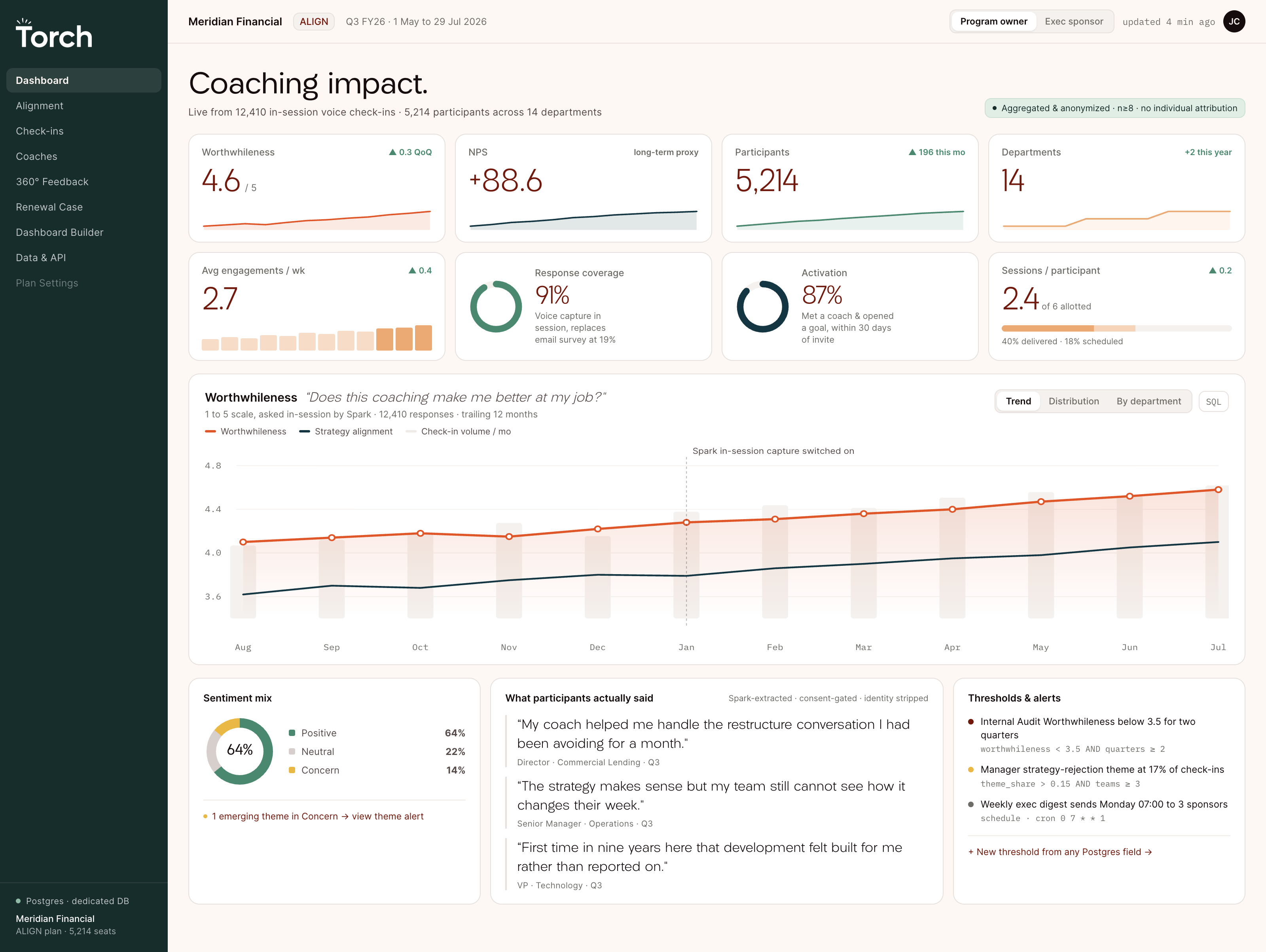
Torch's Worthwhileness dashboard concept demonstrates how participants' views on coaching's usefulness can be displayed alongside participation and engagement data. This offers a practical reporting design to discuss when determining what your program team needs to track.
 View full size
Maintain separate evaluations of engagement, behavior feedback and business results. This approach makes the renewal discussion more valuable than combining all metrics into a single success score.
Get quotes you can actually compare
A shorter sprint doesn't necessarily mean lower overall costs. Participant numbers, expert hours, coaching frequency and platform fees can affect the comparison. Additional development purchases after an initial engagement can also change the calculation.
Provide both teams with the same requirements: who needs support, their working languages, the business context, available time and the evidence you want at the program's end. Then ask:
- What does each participant receive? Detail sessions, duration, follow-up activities, assessments and any AI access.
- What is charged separately? List implementation, customization, platform fees, reporting and additional practice products.
- What happens when plans change? Review policies for unused spots, rescheduling, rematching, extensions and renewal terms.
- What does our team need to do? Identify who will handle invitations, manager involvement, integrations and reporting.
- What must be ready before launch? Agree on the matching process, procurement steps and assessment requirements, and set a realistic first-session date.
If you're replacing a provider, include a specific continuity question. Ask about the handling of active participants, existing coach relationships and historical assessment data. Portability and comparability need to be agreed upon; they shouldn't be assumed from the word “transition.”
Make confidentiality part of the decision
A leader needs to understand what stays confidential before discussing a sensitive situation. Ask both providers to demonstrate the participant, coach, manager and administrator views using the products in your proposal.
Torch's Spark guidance indicates that conversation transcripts remain private to the participant and audio is not stored. Verify the reporting arrangements for any separate scored-practice product. Torch also publishes its security controls and audit information.
Growthspace publishes a Privacy Notice covering GDPR-related rights, processing roles and international transfers. Use this as a foundation for your contractual discussion. For either provider, request the applicable security reports, data-processing terms, retention rules and access controls for your proposed setup.
Which provider belongs on your shortlist?
Start with Torch when…
You want seasoned, credentialed coaches working with leaders on shared business priorities. You value a continuing relationship, an agreed mix of coaching formats and feedback that helps assess development throughout the engagement.
Start with Growthspace when…
You can define a specific development goal and want a practitioner with relevant industry or functional experience. You prefer starting with a sprint, or want to explore ExpertX for learning based on your organization's own content.
If both providers remain on your shortlist, present them with the same real leadership situation. Ask each team to show the proposed expert or coach, the participant's first few weeks and the evidence you would review later. That discussion will be more informative than a longer feature checklist.
Sources and further reading
- Growthspace: platform and delivery, expert standards, leadership development, ExpertX and privacy.
- Torch: program approach, coach standards, AI practice and platform reporting.
Frequently asked questions
What is Torch?
Torch is a leadership coaching and alignment platform for talent teams. Its experienced, ICF-credentialed coaches work with leaders in the context of their company’s priorities. Programs can include individual, group or team coaching, with measurement and optional AI practice scoped to the engagement.
Does Growthspace offer leadership coaching?
Yes. Growthspace offers executive and leadership development, including organizational leadership, change leadership and succession preparation. Its model emphasizes focused development with domain experts. A short sprint describes the delivery format, not a limit on the leadership topics it can address.
How long is a Growthspace sprint?
Growthspace describes a typical program as five one-hour expert sessions over six to eight weeks, with follow-up work between meetings. Ask how further development is arranged after that sprint and whether an ongoing relationship with the same expert is available for your program.
How do Spark and ExpertX differ?
Spark provides unscored conversation rehearsal. Growthspace’s ExpertX includes knowledge, presentation, role-play and coaching agents built around organizational expertise. Torch also offers scored skills practice from Praxis Labs by Torch. Confirm which products, scenarios and reporting are included in each proposal.
Is Growthspace cheaper than Torch?
You need quotes for the same population and scope to answer that. Compare expert or coach hours, program length, platform fees, AI access, assessments, implementation and renewal terms. A shorter engagement or an annual contract benchmark alone does not establish the lower total cost.
Can we compare the providers’ impact figures directly?
Only when the measures, participants, time periods and methods are comparable. Goal attainment, manager-observed improvement and changes in 360 ratings answer different questions. Ask each provider for a relevant customer example and the detail behind the result you intend to use in your business case.
Keep comparing with a clear brief.


Become a Torch Changemaker.