
Torch vs Sounding Board: which fits your coaching program?

In this article
When evaluating Torch and Sounding Board, first consider your program goals: What specific behaviors do you want your leaders to change, and what type of support will help them succeed? Both platforms offer human coaching and can align development with business objectives. However, they differ in how they select coaches, support program management, facilitate practice between coaching sessions, and provide evidence for renewal.
Torch merits consideration when you need experienced coaches working toward agreed leadership capacities, with a 360 assessment conducted both before and after the engagement. Sounding Board is worth examining when you also need to manage internal coaches or mentors, or want to build on existing training programs. Its offering includes external coaching as well.
- Delivered coaching is available from both. Sounding Board also offers program design and external coaching.
- Check the actual coach shortlist. When reviewing coaches, consider credentials, relevant experience and availability as a package.
- Explore practice between sessions. Torch provides AI conversation rehearsal and scored skills practice as separate options.
- Agree on evidence before launch. Attendance, participant feedback and observed behavior answer different questions about a program.
Both can deliver coaching around your business
Sounding Board offers multiple program-building approaches. Guide combines program design with its external coach network, linking capabilities to business initiatives. Expand provides tools for internal development programs. Transform integrates both internal and external resources with implementation and customer support.
This flexibility is valuable if your organization already has qualified internal coaches, a mentoring network, or multiple development programs to coordinate. Its Mentoring Module helps connect your own mentors and mentees. Sounding Board’s Leadership Studios also offers group coaching to supplement existing training. For talent teams looking to convert an established curriculum into practical workplace application, this provides a specific reason to explore it.
Torch begins with the leadership work required by your strategy. Its leadership-capacity framework can help make that work concrete: perhaps managers need to delegate with clearer accountability, or senior leaders need to make decisions across competing priorities. The coaching and assessment plan should align with these strategic choices.
Specify who needs to develop together
Torch’s dynamic team coaching focuses on one coach with an intact team, including its manager. The emphasis is on collective performance: how the team makes decisions, handles disagreement and delivers on shared commitments. Ask each provider to explain how an intact-team engagement differs from a peer group applying a training curriculum.
Torch’s Sponsored Mentoring Program pairs an internal executive sponsor with professional coaching for emerging leaders. The sponsor opens doors, advocates for the leader and provides access to stretch work, while the coach helps the leader develop through these experiences. Torch selects sponsor pairings for approval and matches each leader with an appropriate coach. Consider who provides each role, alongside any software used to coordinate the program.
For instance, if reorganization is causing decision delays, give both vendors the same brief: identify affected leaders, pinpoint decision bottlenecks and describe improved behaviors. Ask each to demonstrate how this context reaches their coaches. A shared customization promise only becomes valuable when you can review the actual program design.
The coach matters more than the network headline
Every Torch coach is ICF-credentialed and has at least five years of coaching experience. This establishes a clear entry standard for buyers. Torch’s published profiles also allow you to review the specific leadership roles, industries and situations that individual coaches understand.
Sounding Board similarly offers experienced leadership coaches. Its coach requirements include accredited certification, with ICF and EMCC given as examples, and a live coaching demonstration as part of the qualification process. Both providers maintain professional standards; evaluate these standards alongside the experience of coaches proposed for your team.
Request a small, representative shortlist tailored to your population. A coach effective with newly promoted managers may differ from one supporting a divisional president through acquisition. Inquire about relevant experience, language capabilities, time-zone availability and the process if the initial match proves unsuccessful.
The true test is whether the proposed coaches can help your leaders examine tough decisions and change their approach. A large network increases matching possibilities; it doesn't tell you who will actually coach your people.
What happens between sessions?
Sounding Board’s individual coaching offer features messaging with coaches and a Leadership Roadmap for tracking goals, actions and progress. Its on-demand module can also facilitate access to internal or third-party coaches between scheduled sessions.
Torch provides two different forms of AI practice. Spark offers unscored rehearsal and reflection for conversations. The scored skills-practice library from Praxis Labs by Torch contains 17 workplace scenarios with four-level skill rubrics. Practice and reporting needs should be defined within the program scope.
Decide based on a real use case. A manager preparing for tomorrow’s difficult conversation might prefer rehearsal. A cohort repeatedly working on feedback skills may benefit from assigned scored practice. Neither use should be evaluated by the number of AI features on a presentation; ask to see the participant experience and resulting feedback.
Ask what the measurement will actually tell you
Torch’s program begins and ends with a 360 assessment that scores participants against agreed leadership capacities. By keeping the assessment consistent, you can track how raters' feedback evolves over time. Their program reporting can bring this feedback alongside other program information.
Wellstar’s account of its Sounding Board program demonstrates how coaching can align with an employer’s existing assessment framework. Wellstar built its coaching program around its 360 assessment, focusing on development around the health system’s values, manager feedback and a historical retention comparison. Consider whether a similar assessment design would be part of your own program.
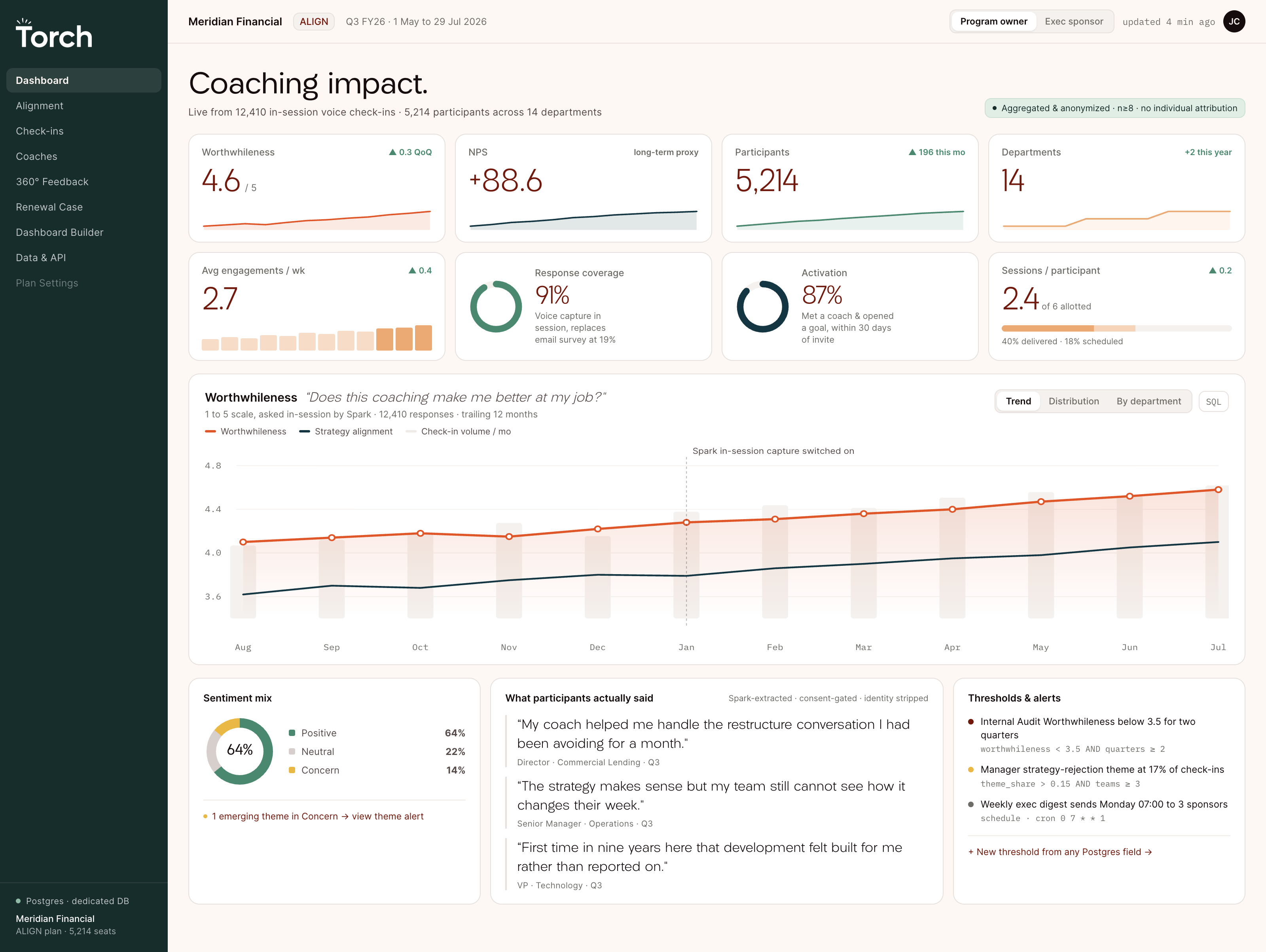
Torch’s Worthwhileness dashboard concept demonstrates how participants’ views of coaching’s usefulness can sit alongside participation and engagement. Use this design to determine what information a program manager needs and how that data should guide decision-making.
 View full size
For either option, examine the measurement approach closely. Who will complete the assessments? Will the same questions and raters be used in follow-ups? How are missing responses addressed? When managers report improvements, is this based on general impressions or specific ratings against defined behaviors?
A before-and-after 360 assessment can facilitate valuable development discussions. However, it alone cannot prove that coaching caused changes in retention, performance, or revenue. If financial ROI is important, you'll need to agree separately on the costs, business outcomes, and assumptions required for its assessment. Torch’s illustrative renewal example clearly outlines these distinctions.
Compare complete proposals, not platform fees
Give both providers the same population, goals, and timeframe. Then compare the specific work each provider commits to deliver. A software license for internal coaches and a program with external coaching hours can both be valid purchases, but their headline prices address different needs.
| Item | What to put side by side |
|---|---|
| Coaching allocation | Sessions per person, session length, term and unused-session rules. |
| Assessment | Baseline and follow-up scope, administration and reporting. |
| Software and practice | Included modules, optional AI access and additional fees. |
| Program delivery | Who handles design, enrollment, matching, reminders and support. |
| Commercial terms | Minimum commitment, changes in participant numbers and renewal terms. |
This approach also clarifies internal workload requirements. Identify which tasks your team will handle and which the provider will manage. Determine who is responsible when enrollment stalls or a leader needs a new coach. These responsibilities can impact a proposal’s value as much as the session rate.
Decide how to allocate the annual budget
Torch’s L&D catalogue lets a buyer commit an annual budget and draw from it as services are selected throughout the year. This adds a purchasing consideration to the program management comparison: which services can be funded, at what rates and with what booking conditions? Verify unused-budget terms and delivery responsibilities in the proposal; a catalogue arrangement alone doesn’t define the coaching experience.
Make security and switching specific
Torch describes annual SOC 2 Type II and ISO 27001 audits. Sounding Board describes its SOC 2 Type I and Type II audits, SAML single sign-on and encryption controls. Begin procurement by reviewing the current reports and the exact services they cover, then examine access, retention, and deletion requirements with your security team.
Torch’s Spark documentation states that its transcripts remain private to the participant and no audio is saved. Verify data handling and reporting for scored practice separately, rather than assuming one feature’s policy covers the entire program.
Before setting a launch date for your program move, list what must be preserved. Participant lists, assessment records and private coaching records each have different permission and portability requirements. Ask which items can transfer, what needs new baselines and whether existing coach relationships can continue. Frame these as scoping questions, not assumed migration features.
Which should you shortlist first?
Start with Torch when the coaching and assessment design lead the decision
Torch is a strong fit when you want its published coach standard, development around agreed leadership capacities and a planned before-and-after assessment. You can add rehearsal or scored practice between sessions. Bring a specific leadership challenge and ask how these elements would combine for your team.
Start with Sounding Board when you need to coordinate internal and external development
Consider Sounding Board when your organization already runs coaching, mentoring or training and needs tools to link them. Its external coaching remains viable even without internal coaches. Ask which package suits your needs rather than viewing the whole offering as a software license.
If both stay on your shortlist, give them one actual cohort brief and compare the proposed coaches, responsibilities and evidence plan.
Frequently asked questions
Is Sounding Board only software for internal coaches?
No. Its Guide offering combines program design with Sounding Board coaches. Expand supports internal programs, while Transform combines internal and external resources. Choose the relevant package before comparing its proposal with Torch.
Does Sounding Board support coaching around company priorities?
Yes. Guide describes selecting capabilities for business initiatives. Wellstar also documents a program built around its own values and 360 assessment. Company context is shared ground; ask how each provider will use yours in practice.
Does Torch offer scored AI practice?
Yes, through the skills-practice library from Praxis Labs by Torch. It is distinct from Spark’s unscored rehearsal. Discuss which practice product and reporting setup belong in your program.
Can a before-and-after 360 prove that coaching worked?
It can show changes in how raters describe a leader’s behavior. By itself, it cannot establish that coaching caused those changes or calculate financial ROI. Consistent questions, rater continuity and follow-up participation make the comparison more useful.
Which platform costs less?
A like-for-like proposal is needed to answer that. Compare the same population, session allocation, assessment schedule, software modules and support responsibilities over the same term. A platform-only fee and a delivered coaching program are different purchases.
What is Torch?
Torch is a leadership coaching and alignment platform for mid-market and enterprise talent teams. It combines experienced ICF-credentialed coaches, development around company priorities, and before-and-after 360 feedback. Optional AI practice can support work between sessions. In this comparison, evaluate that program design alongside Sounding Board’s delivered coaching and internal-program tools.
Keep comparing with a clear brief.


Become a Torch Changemaker.